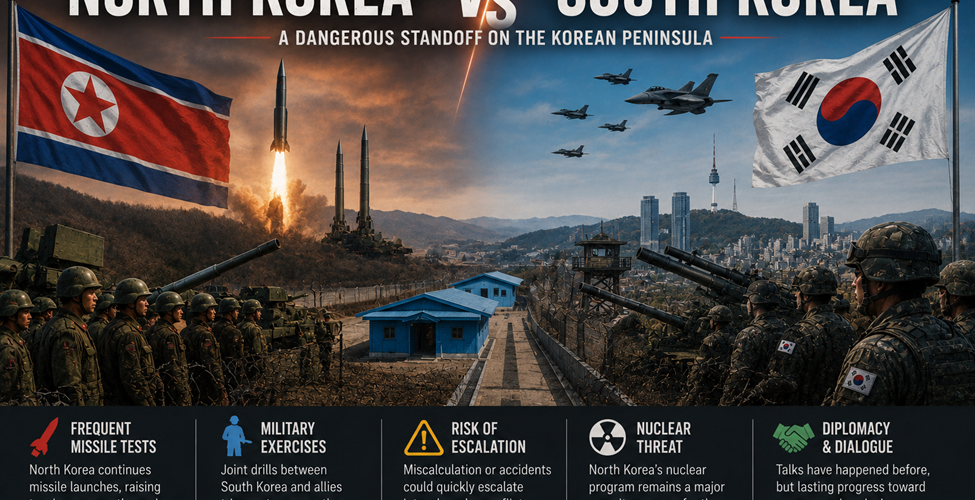
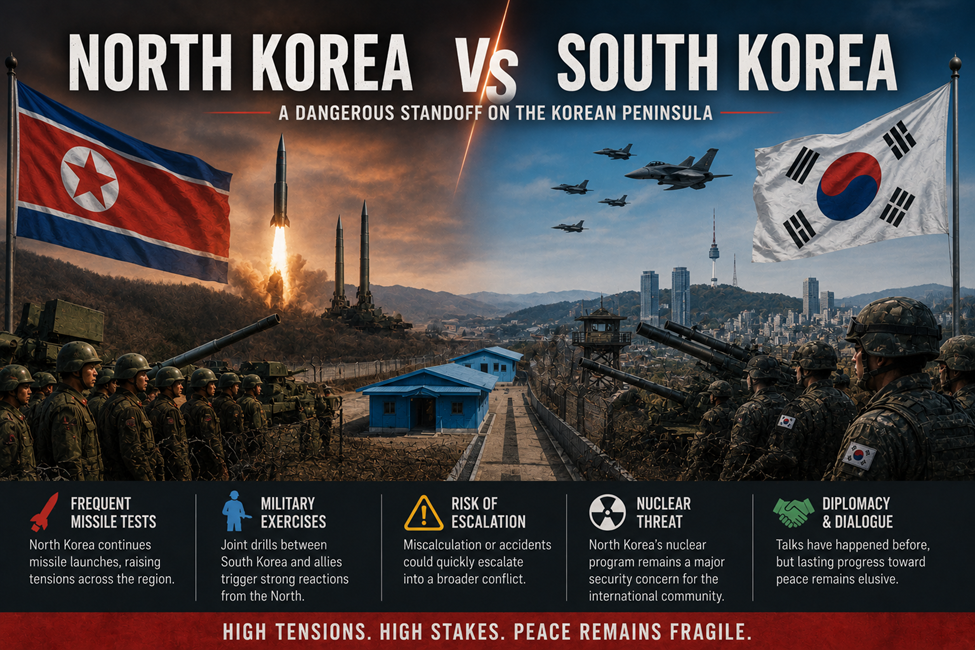
The Korean Peninsula continues to represent one of the most heavily militarized and closely monitored regions in the world, where decades of hostility between North Korea and South Korea remain a persistent source of international concern.
Although active warfare ended with an armistice in 1953, the Korean War never formally concluded with a peace treaty. As a result, North and South Korea technically remain in a state of war more than seventy years later.
Tensions regularly rise and fall as both sides engage in military exercises, political confrontations and competing security strategies. Missile launches by North Korea and joint military drills involving South Korea and its allies frequently trigger periods of heightened uncertainty across the region.
North Korea continues to expand its missile and nuclear capabilities, presenting them as essential tools for national defense and deterrence. Pyongyang argues that military exercises conducted by South Korea and the United States represent direct security threats that justify continued weapons development.
South Korea, meanwhile, maintains that a strong defensive posture is necessary to deter aggression and protect its population. Seoul works closely with the United States and other regional partners to strengthen military readiness and maintain stability on the peninsula.
The Demilitarized Zone separating the two Koreas remains one of the world’s most fortified borders. Despite its name, the area is surrounded by extensive military infrastructure and serves as a visible reminder of the unresolved conflict.
Military analysts warn that the greatest risk may not come from a deliberate decision to start a war, but from miscalculation or misunderstanding during periods of heightened tension. Missile tests, naval incidents, airspace violations or military exercises all carry the potential to trigger unintended escalation.
The security implications extend well beyond the Korean Peninsula. Japan, China, Russia and the United States all closely monitor developments, recognizing that any conflict could rapidly become an international crisis with far reaching consequences.
North Korea’s nuclear arsenal remains a central concern for global policymakers. International efforts aimed at limiting Pyongyang’s nuclear program have produced periods of dialogue but have yet to achieve a lasting breakthrough.
At the same time, South Korea has emerged as one of Asia’s leading economies and technological powers. Continued instability on the peninsula therefore carries significant implications for global trade, financial markets and supply chains.
Diplomatic engagement between the two Koreas has occasionally produced moments of optimism, including high level summits and military confidence building measures. However, many of these initiatives have struggled to survive periods of renewed political and military tension.
In a significant shift, North Korea has moved away from the long-held goal of eventual reunification. Beginning in 2024, leader Kim Jong Un declared peaceful reunification no longer possible and designated South Korea a hostile state, and by 2026 Pyongyang had removed references to reunification from its constitution. South Korea, under an administration that took office in 2025, has continued to seek dialogue, but the North has so far rejected those overtures.
For people living on both sides of the border, the division of the peninsula remains deeply personal. Millions of families were separated during the Korean War, and many have never been reunited.
Despite recurring crises, experts generally believe that all major parties seek to avoid a full scale conflict. Nevertheless, the combination of military forces, advanced missile systems and nuclear weapons ensures that even a limited incident could have serious consequences.
As North Korea continues its weapons development programs and South Korea strengthens its defense partnerships, the Korean Peninsula remains one of the world’s most dangerous flashpoints and a critical test of regional security in Northeast Asia.
The challenge facing diplomats and military planners alike is ensuring that competition and deterrence do not give way to confrontation, preserving stability in a region where the costs of conflict would be immense.


0 Comments
Leave a Comment