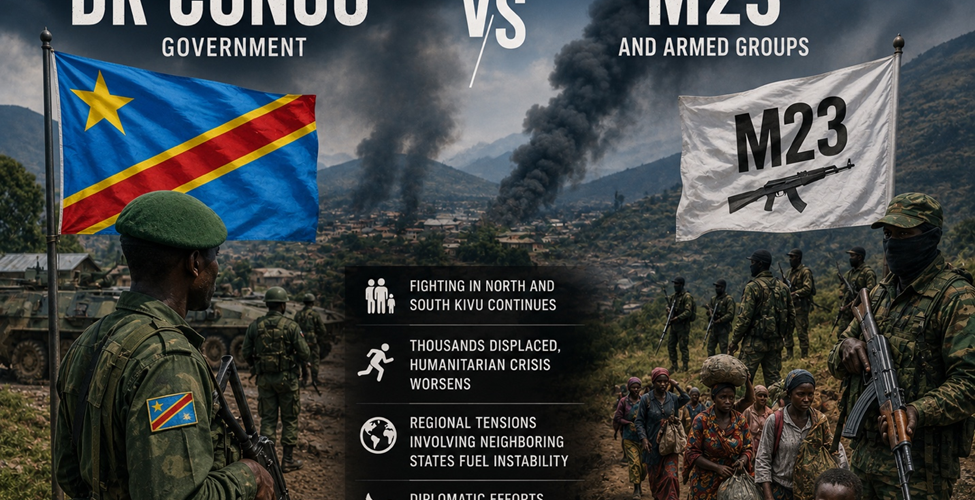
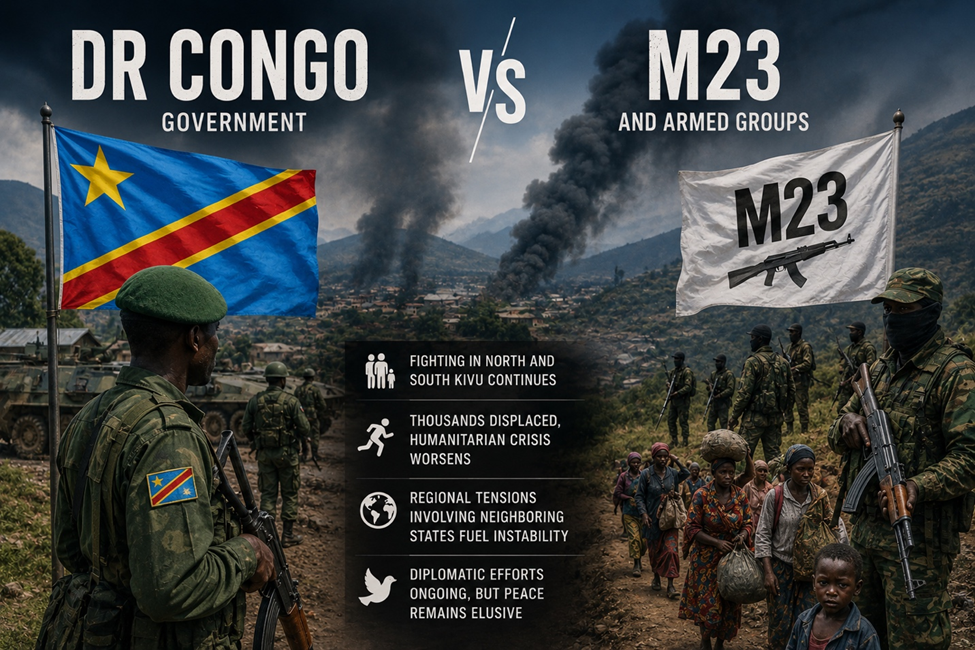
The conflict in the eastern Democratic Republic of Congo continues to fuel one of Africa’s most complex and persistent security crises, with renewed fighting between government forces, the M23 rebel movement and numerous armed groups displacing hundreds of thousands of civilians.
Despite repeated diplomatic efforts and regional mediation initiatives, violence across North Kivu and South Kivu provinces remains a major source of instability, threatening both local communities and broader regional security.
The Democratic Republic of Congo, a country rich in natural resources including cobalt, gold and coltan, has struggled for decades with armed insurgencies, ethnic tensions and competition over territory and mineral wealth. The latest escalation involving M23 has become one of the most significant security challenges facing the Congolese government.
Congolese authorities accuse M23 of attempting to seize territory and undermine state control in eastern regions bordering neighboring countries. Government officials have repeatedly pledged to restore security and reestablish full authority across affected provinces.
M23 leaders, meanwhile, argue that they are defending the interests and security of communities they claim have been marginalized. The group maintains that political grievances and unresolved security concerns remain at the heart of the conflict.
International observers note that the crisis extends beyond a simple confrontation between government forces and a single armed movement. Dozens of armed groups operate throughout eastern Congo, creating a highly fragmented security environment that complicates peace efforts and military operations.
The humanitarian consequences have been severe. Families have been forced to flee their homes as fighting moves across rural communities and strategic towns. Aid organizations warn that overcrowded displacement camps, food shortages and limited access to healthcare continue to place vulnerable populations at significant risk.
Humanitarian agencies report that women and children remain among the most affected by the ongoing violence. Access to education, healthcare and essential services has been disrupted in many areas, while insecurity continues to hamper relief operations.
Regional tensions have also added another dimension to the conflict. Relations between the Democratic Republic of Congo and neighboring states have periodically become strained amid accusations of external support for armed groups operating in the region.
Several African governments and regional organizations have called for restraint and renewed dialogue, emphasizing that military solutions alone are unlikely to resolve the underlying causes of instability. Diplomatic initiatives involving regional leaders have sought to reduce tensions and encourage political engagement between the parties.
Security analysts warn that prolonged instability in eastern Congo could have broader implications for Central Africa. The region’s strategic location, cross border trade routes and vast mineral resources make developments in the conflict closely watched by governments and international investors alike.
The fighting has also highlighted the challenges facing peacekeeping and stabilization efforts. International missions operating in the region continue to support civilian protection initiatives, though insecurity and logistical difficulties have limited their effectiveness in some areas.
For many residents of North Kivu and South Kivu, the conflict remains a daily struggle for safety and survival. Communities that have experienced years of recurring violence continue to face uncertainty as armed confrontations persist.
As diplomatic efforts continue and military operations evolve, the future of eastern Congo remains uncertain. What remains clear is that achieving lasting peace will require not only improved security but also meaningful political solutions, economic development and greater regional cooperation.
Until those conditions are met, the Democratic Republic of Congo is likely to remain one of Africa’s most significant conflict zones and a continuing humanitarian concern for the international community.

0 Comments
Leave a Comment