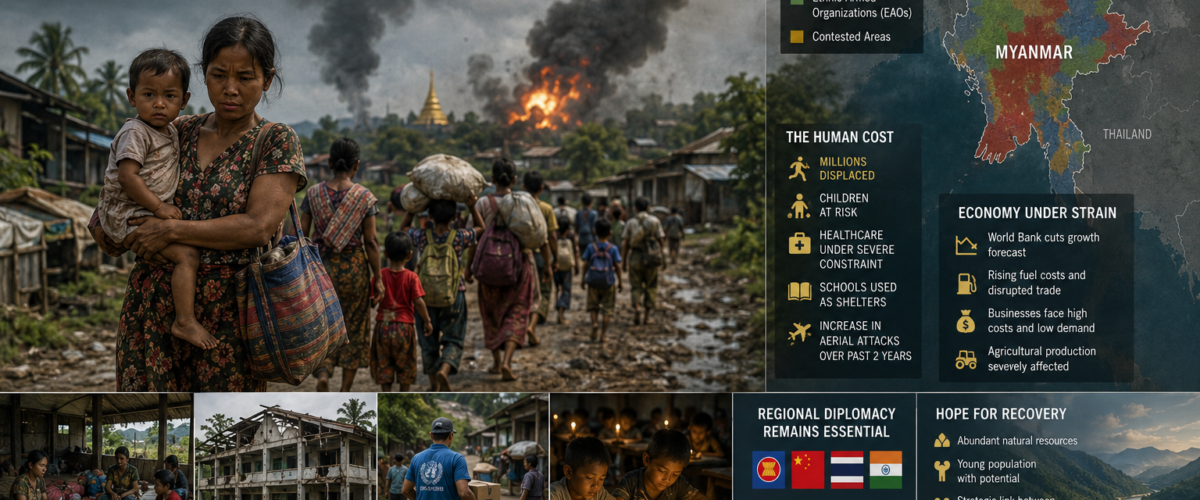
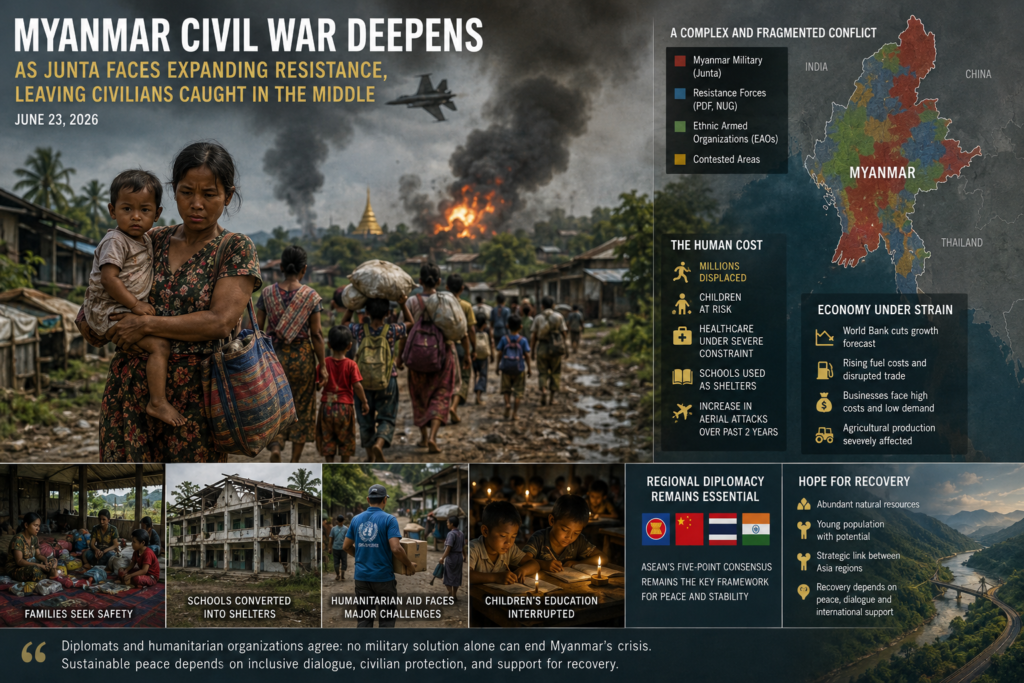
Nearly five and a half years after Myanmar’s military seized power, the country’s civil war has evolved into one of Asia’s most complex and devastating conflicts. While the military continues to hold major urban centres and retains significant air power, resistance forces and long-established ethnic armed organizations now challenge its authority across large parts of the country, creating an increasingly fragmented battlefield with profound humanitarian consequences.
For millions of ordinary Myanmar citizens, however, the conflict is measured less by shifting front lines than by the daily struggle to find safety, food and medical care.
In villages across Sagaing, Magway, Shan, Rakhine and Karen states, families continue to flee repeated air raids and artillery attacks. Schools have been converted into shelters, healthcare facilities operate under severe constraints, and many farmers are unable to cultivate their land because of insecurity or landmines. Humanitarian organizations estimate that millions remain displaced, with women and children accounting for a significant share of those forced from their homes.
“We no longer know when it is safe to return home,” said a volunteer aid worker quoted by local humanitarian organizations. “People carry only what they can. Every new airstrike means another community begins again from nothing.”
Conflict Expands Despite Diplomatic Activity
The conflict traces its roots to the military takeover of February 2021, which overturned the results of the country’s general election and triggered nationwide protests. As peaceful demonstrations were met with force, resistance gradually transformed into an armed movement involving the National Unity Government’s People’s Defence Forces alongside numerous ethnic armed organizations that have fought successive governments for decades.
Since then, the military has lost control over substantial rural territory while continuing to rely heavily on aircraft, drones and artillery to project force into contested regions. Independent monitoring groups report a sharp increase in aerial attacks over the past two years, making air power one of the defining characteristics of the conflict.
Security analysts note that no single actor exercises complete control across Myanmar. Instead, authority is divided among the military, local resistance groups and ethnic organizations, creating an increasingly fragmented security landscape that complicates both governance and humanitarian access.
Economic Pressures Deepen Civilian Hardship
Beyond the violence, Myanmar’s economy remains under severe strain.
The World Bank recently lowered its economic growth forecast, pointing to persistent conflict, higher fuel costs, disrupted trade and the lingering effects of last year’s devastating earthquake. Businesses continue to face rising transportation costs, unreliable electricity supplies and shrinking consumer demand, leaving many families with fewer opportunities to earn a living.
Small business owners in regional towns describe operating in an atmosphere of constant uncertainty.
“Some weeks customers disappear because roads are closed,” one trader told local media. “Other weeks fuel prices make deliveries impossible.”
Economic disruption has also affected agricultural production, cross-border commerce and manufacturing, placing additional pressure on communities already coping with displacement.
Humanitarian Needs Continue to Grow
International humanitarian agencies warn that access to vulnerable populations remains one of the greatest challenges. Aid deliveries frequently require negotiations with multiple armed actors, while damaged infrastructure and ongoing fighting delay assistance to remote communities.
The conflict has also contributed to wider regional challenges, including human trafficking and transnational criminal networks operating along Myanmar’s borders. This week, rights groups warned that more than 5,000 people remain trapped inside online scam compounds near the Thai frontier despite previous multinational rescue operations, underscoring how instability continues to fuel organised crime.
Children remain particularly vulnerable. Interrupted education, displacement and limited healthcare have left many growing up amid prolonged instability, while humanitarian agencies continue to call for greater protection of civilians and unimpeded access for relief operations.
Regional Diplomacy Remains Essential
Myanmar’s crisis continues to test regional diplomacy.
The Association of Southeast Asian Nations (ASEAN) has maintained its Five-Point Consensus as the principal regional framework for encouraging dialogue, reducing violence and expanding humanitarian assistance. Although implementation has proved difficult, ASEAN members continue to stress that a political solution remains essential for lasting stability.
Neighbouring countries, including Thailand, India and China, have sought to balance border security, economic interests and humanitarian concerns. China recently reaffirmed its relationship with Myanmar’s leadership during high-level meetings in Beijing, reflecting Beijing’s continued interest in border stability, infrastructure development and trade connectivity.
The United Nations has repeatedly called for greater protection of civilians, expanded humanitarian access and renewed efforts toward an inclusive political process involving all major stakeholders.
Gulf Nations Support Humanitarian Relief
Although geographically distant, Gulf countries have consistently supported humanitarian relief efforts across conflict-affected regions through international organizations and development partnerships.
The United Arab Emirates has built its foreign policy around dialogue, humanitarian assistance and sustainable development, principles that resonate strongly in crises such as Myanmar. Through cooperation with United Nations agencies and international humanitarian partners, Gulf states continue to advocate solutions that prioritise civilian protection, reconstruction and long-term stability.
Analysts say that middle-power diplomacy, combined with humanitarian financing and development expertise, could become increasingly valuable if political conditions eventually permit broader reconstruction efforts.
The Long Road Toward Recovery
Peace remains elusive, but many observers argue that the foundations for eventual recovery already exist.
Myanmar possesses abundant natural resources, a young population and strategic links between South Asia, Southeast Asia and China. Should violence subside, rebuilding transport networks, restoring public services and attracting responsible investment could help revive local economies and create opportunities for displaced communities to return home.
For now, however, ordinary families continue to bear the greatest burden.
Across temporary camps, monasteries and makeshift shelters, parents focus on finding clean water, protecting their children and preserving a sense of normality despite years of uncertainty.
Diplomats and humanitarian organizations broadly agree that no military solution alone is likely to end Myanmar’s crisis. Sustainable peace will ultimately depend on inclusive dialogue, confidence-building among rival actors, protection of civilians and coordinated international support for recovery.
Until then, millions of Myanmar’s people remain suspended between conflict and hope, waiting for the day when rebuilding can finally replace survival.

0 Comments
Leave a Comment