The Election Speech
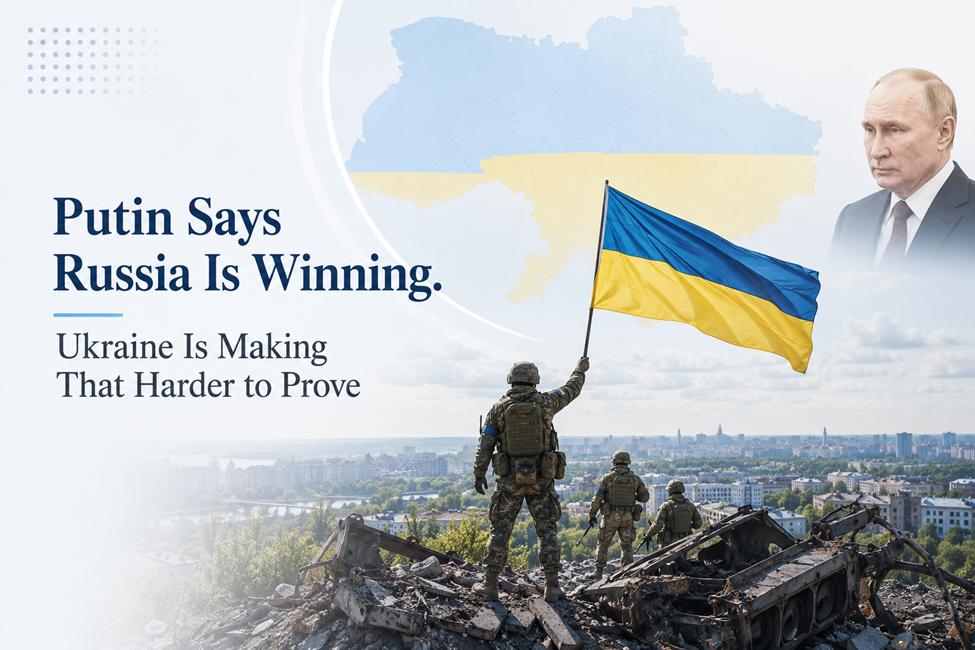
On 28 June, Vladimir Putin, the President of the Russian Federation, addressed the ruling United Russia party congress ahead of September parliamentary elections and delivered a single message: Russia is winning and will not stop.
Ukrainian forces, he claimed, were retreating along the entire front and resorting to “outright terrorist acts” because they could not stop Russia militarly. He rejected Ukraine’s proposal for a mutual halt to long-range strikes and said Moscow would continue until it achieved what he called the full “liberation” of Donbas and “Novorossiya.” Reuters reported that Putin vowed to press on regardless of Kyiv’s proposal. (Reuters)
This was not a routine party appearance. United Russia placed a wounded Ukraine war veteran and a state television war correspondent among its lead candidates, alongside Foreign Minister Sergei Lavrov. The war is no longer only state policy. It is becoming part of the ruling party’s electoral identity. (Reuters)
That makes Putin’s remarks programmatic. They set the line for loyal candidates, regional elites and state media: no retreat, no compromise, no acknowledgement that Russia’s original war aims have failed.
The Imperial Map
Putin’s territorial vocabulary is doing political work. He speaks of Donbas and “Novorossiya,” an imperial-era term that reaches beyond the territory Russia actually controls. Russia claims to have annexed Donetsk, Luhansk, Zaporizhzhia and Kherson regions, but it does not fully occupy all of them.
That gap matters. By expanding the language of what Russia says it is defending, the Kremlin can present Ukrainian strikes on refineries, military plants, airports and fuel depots as attacks on the homeland. “Novorossiya” is not a stable military map. It is a political concept used to absorb setbacks and justify continued mobilisation.
Ukraine’s War-Tech Answer
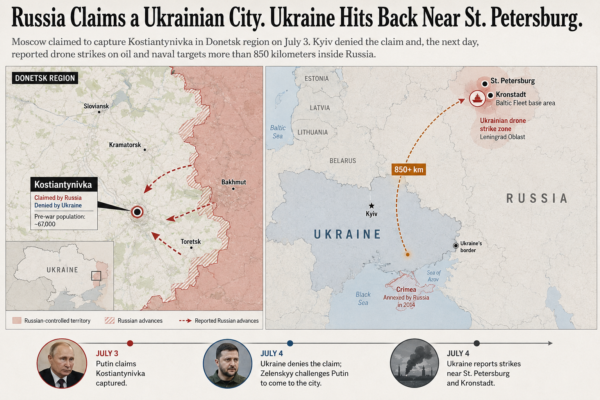
While Putin was describing Ukrainian collapse, Ukraine was demonstrating something different: a growing ability to strike the systems that sustain Russia’s war.
Ukrainian and open-source reporting said Ukrainian FP-5 Flamingo cruise missiles struck the Titan-Barrikady plant in Volgograd, a facility linked to launch systems for Russia’s Iskander-M, Yars and Topol-M missile complexes. The details still require caution, but the direction is clear: Ukraine is increasingly able to reach strategic military infrastructure deep inside Russia. (Reuters)
That contrast is important. Titan-Barrikady is a legacy Soviet defence enterprise. Fire Point, the Ukrainian company associated with Flamingo and other long-range systems, represents a different model: battlefield feedback, private-sector engineering, fast iteration and rapid scaling. Reuters has described Ukraine’s defence-tech revolution as drawing open interest from U.S. and European officials because Ukrainian firms are adapting weapons and software directly from battlefield experience. (Reuters)
Fire Point also points to the next stage. Reuters reported in June that the company is preparing flight tests for its FP-9 ballistic missile, with a reported range of up to 850 km and an 800-kg warhead. If successful, such systems would place Moscow within range of Ukrainian ballistic missiles. (Reuters)
Ukraine is not only absorbing Russian pressure. It is building a defence-tech system under fire.
The War Reaches Russia’s Fuel System
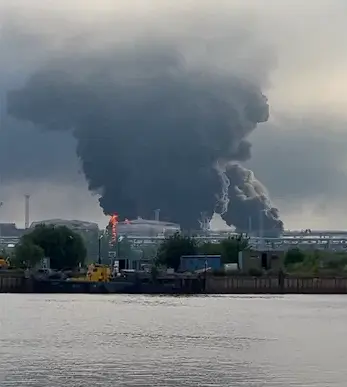
The strategic effect of Ukraine’s strike campaign is now visible inside Russia. Reuters reported that fuel shortages have spread from occupied Crimea to southern Russia, Siberia and Moscow, with queues or purchase limits in many regions. Putin has acknowledged fuel shortages linked partly to Ukrainian attacks while insisting the state can manage the problem. (Reuters)
Russian authorities are considering extraordinary measures. Reuters reported that Moscow may temporarily allow the production and import of lower-quality gasoline and diesel to ease the crisis, reintroducing a fuel standard banned in 2013. (Reuters)
This is the point Putin’s victory narrative cannot easily explain. Ukraine does not need to occupy Russian territory to change Russian calculations. It can make Russia’s depth unsafe, force the Kremlin to defend refineries and fuel depots, disrupt airports, and turn ordinary logistics into a domestic political problem.
What Moscow Cannot Admit
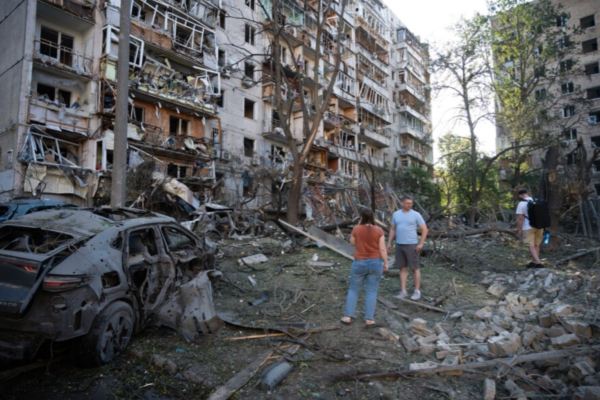
Russia remains dangerous. It is still advancing in places, especially in Donetsk, and continues to attack Ukrainian cities. Reuters reported that Russian strikes on Dnipro, Zaporizhzhia and Kharkiv killed at least 10 people in late June. (Reuters)
But Russia is not achieving the clean strategic victory Putin describes. Zelenskyy has mocked Moscow’s repeated missed deadlines for capturing Ukrainian regions and pointed to fuel shortages inside an oil-producing state. (Reuters)
Ivan Krastev warned in the Financial Times that the window for peace will not remain open forever, partly because Putin still believes he can achieve total victory. That reading helps explain the United Russia speech: Putin is not only selling victory to Russian voters; he is locking himself into a narrative that makes compromise harder to present as anything other than weakness. (Financial Times) Putin went to United Russia to say Russia is winning. The battlefield, the fuel shortages, the refinery fires and the repeated postponement of Moscow’s own deadlines say something more complicated: Russia is still powerful, brutal and capable of escalation, but it has not solved Ukraine. Instead, Ukraine is becoming the hardest kind of opponent for Moscow — a state that refuses to collapse, learns faster under pressure, and can now bring the war back into Russia’s own infrastructure.

0 Comments
Leave a Comment