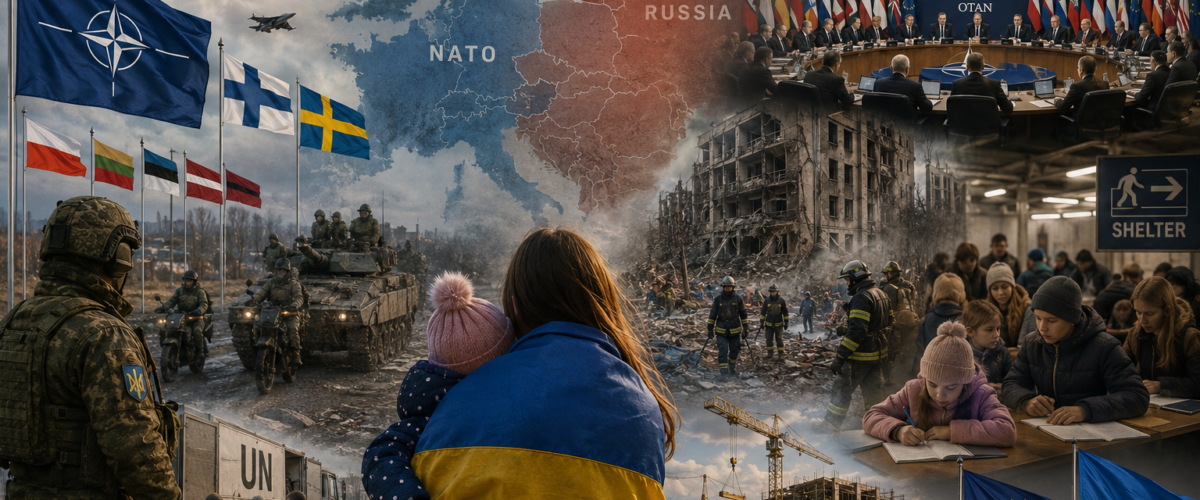
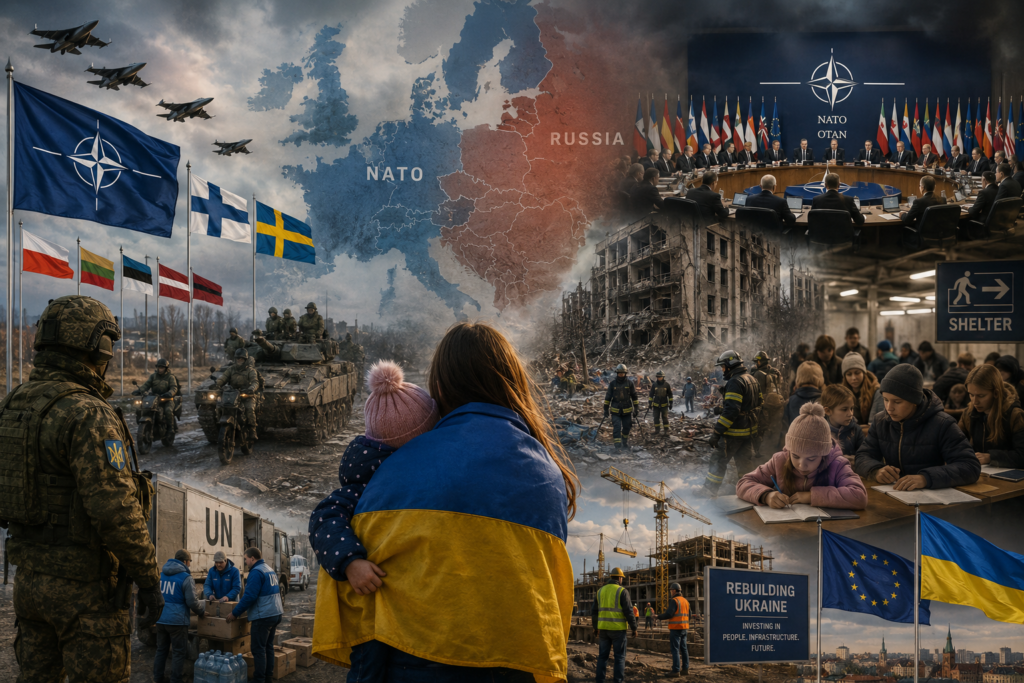
Europe is entering a new period of strategic uncertainty as the confrontation between Russia and NATO continues to redefine the continent’s security landscape. More than four years after Russia’s full-scale invasion of Ukraine, the conflict has expanded far beyond the front lines, influencing military planning, economic resilience, energy policy and the future of the transatlantic alliance.
Recent developments underscore a dual reality. European governments are accelerating defence investments and strengthening military preparedness, while diplomatic channels—although limited—remain active as policymakers seek to reduce the risk of a broader confrontation. The challenge facing Europe is no longer simply how to respond to the war in Ukraine, but how to build a durable security framework capable of preventing future crises.
For ordinary people, the geopolitical debate is deeply personal.
In towns across eastern Poland, the Baltic states and Finland, military exercises and increased troop movements have become part of daily life. Families living close to NATO’s eastern frontier have adapted to heightened security, while communities continue preparing for emergencies that once seemed unimaginable.
Inside Ukraine, millions continue to live under the shadow of missile and drone attacks. Children attend classes in underground shelters when necessary, businesses operate despite repeated disruptions to electricity, and families remain separated by displacement or military service.
“The hardest part is the uncertainty,” said Olena, a teacher originally from eastern Ukraine who now lives in western Europe. “Children ask when they will see their homes again. We try to give them hope, even when we don’t know the answer ourselves.”
Humanitarian agencies say the emotional impact of the conflict has become one of its most enduring consequences. Beyond damaged buildings and infrastructure, many communities face long-term psychological trauma that will require years of recovery.
Military planning is evolving rapidly.
NATO has continued reinforcing its eastern flank through multinational deployments, expanded air policing missions, improved logistics networks and investments in missile defence. The accession of Finland and Sweden has fundamentally reshaped security planning across northern Europe, extending NATO’s direct border with Russia and strengthening cooperation throughout the Baltic region.
At a meeting of NATO defence ministers in Brussels this month, Secretary General Mark Rutte said European allies and Canada were assuming greater responsibility as the United States adjusted some of its military contributions to NATO’s force model. He stressed that the changes reflected a stronger European role within the alliance rather than a weakening of transatlantic cooperation, while urging allies to continue increasing defence investment and industrial production ahead of next month’s NATO summit in Ankara.
Debate over burden-sharing nevertheless remains one of the alliance’s defining political questions.
Washington has encouraged European allies to assume greater responsibility for collective defence, prompting governments across Europe to increase military spending, expand domestic defence industries and modernise armed forces. Many analysts view these investments not only as a response to Russia but also as preparation for a future in which European security depends more heavily on European capabilities.
Russia, meanwhile, continues to portray NATO’s enlargement and military activities near its borders as direct threats to its national security. Moscow maintains that its military posture is defensive, while Western governments argue that NATO remains a defensive alliance whose measures are intended to deter further aggression.
Despite entrenched positions, diplomacy has not disappeared.
European officials have maintained limited communication channels with Moscow to reduce the risk of unintended escalation and preserve opportunities for future negotiations. Although these contacts fall far short of formal peace talks, diplomats say sustained communication remains essential between nuclear-armed powers, particularly during periods of heightened military activity.
European leaders continue to insist that any future settlement must uphold Ukraine’s sovereignty, respect international law and provide credible security guarantees capable of preventing renewed conflict.
The humanitarian dimension remains central.
According to the United Nations, millions of Ukrainians remain displaced inside their country or elsewhere across Europe, while large areas continue to require reconstruction of housing, schools, hospitals, transport links and energy infrastructure. International humanitarian organisations are expanding programmes that provide medical care, education, psychological support and livelihoods alongside emergency assistance.
“Rebuilding a community means restoring confidence as much as rebuilding roads,” said one humanitarian coordinator working in central Ukraine. “People need jobs, functioning schools and the belief that their children can plan for the future.”
Economic recovery is increasingly viewed as an integral component of long-term security.
European governments, international financial institutions and development partners are preparing long-term reconstruction initiatives designed to attract private investment, restore critical infrastructure and strengthen local businesses when conditions permit. Ukrainian entrepreneurs continue opening businesses despite wartime challenges, providing employment and helping communities maintain a sense of normality.
The war has also accelerated Europe’s efforts to diversify energy supplies, strengthen critical infrastructure and improve resilience against cyberattacks and hybrid threats. Policymakers increasingly regard cybersecurity, energy security and supply-chain resilience as essential elements of national defence.
International organisations remain at the centre of these efforts.
The European Union continues providing financial, humanitarian and military assistance to Ukraine while coordinating sanctions against Russia. The United Nations and its humanitarian agencies remain deeply involved in civilian relief operations, while the Organization for Security and Co-operation in Europe continues supporting dialogue and confidence-building initiatives where political space allows.
Middle powers have also assumed increasingly important diplomatic roles.
The United Arab Emirates has consistently advocated dialogue, de-escalation and peaceful conflict resolution while providing humanitarian assistance to civilians affected by the war. Abu Dhabi has facilitated several prisoner exchanges and maintained communication with multiple stakeholders, reflecting its broader foreign policy emphasis on mediation, humanitarian action and practical diplomacy.
Analysts say countries able to engage constructively with different parties may become increasingly valuable if formal negotiations gain momentum in the future.
“There will eventually need to be a security framework that addresses legitimate security concerns while fully respecting sovereignty and international law,” said a European security analyst. “Military deterrence can reduce risks, but lasting stability ultimately depends on political agreements that are credible and sustainable.”
For businesses across Europe, geopolitical uncertainty continues to influence investment decisions. Manufacturers, logistics companies and exporters closely monitor defence policies, energy markets and supply chains, even as many have adapted to operating in a more volatile environment.
The implications extend well beyond Europe.
The conflict has intensified global discussions about defence spending, technological resilience, cybersecurity, energy diversification and the future role of international institutions. It has also highlighted the growing importance of trusted diplomatic intermediaries capable of maintaining dialogue during periods of confrontation.
As Europe prepares for another phase of strategic adjustment, governments face the difficult task of balancing credible deterrence with sustained diplomacy.
History suggests that durable peace rarely emerges through military strength alone. It also requires humanitarian commitment, economic recovery, functioning institutions and political dialogue capable of rebuilding trust after conflict.
For Ukrainian families hoping to return home, children waiting to resume uninterrupted schooling and business owners trying to rebuild their livelihoods, those ambitions are not abstract diplomatic objectives. They represent the possibility that Europe’s most serious security crisis in decades may eventually give way to a more stable, secure and peaceful future.

0 Comments
Leave a Comment