June 29, 2026.
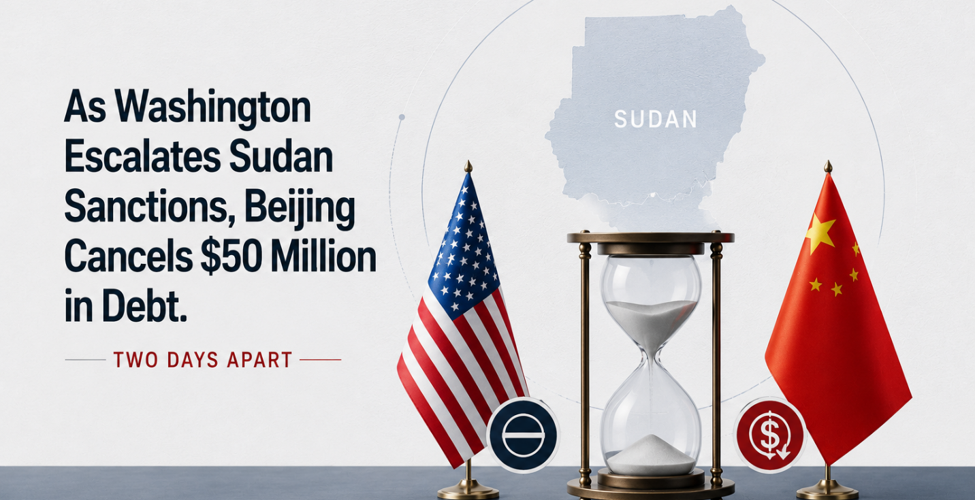
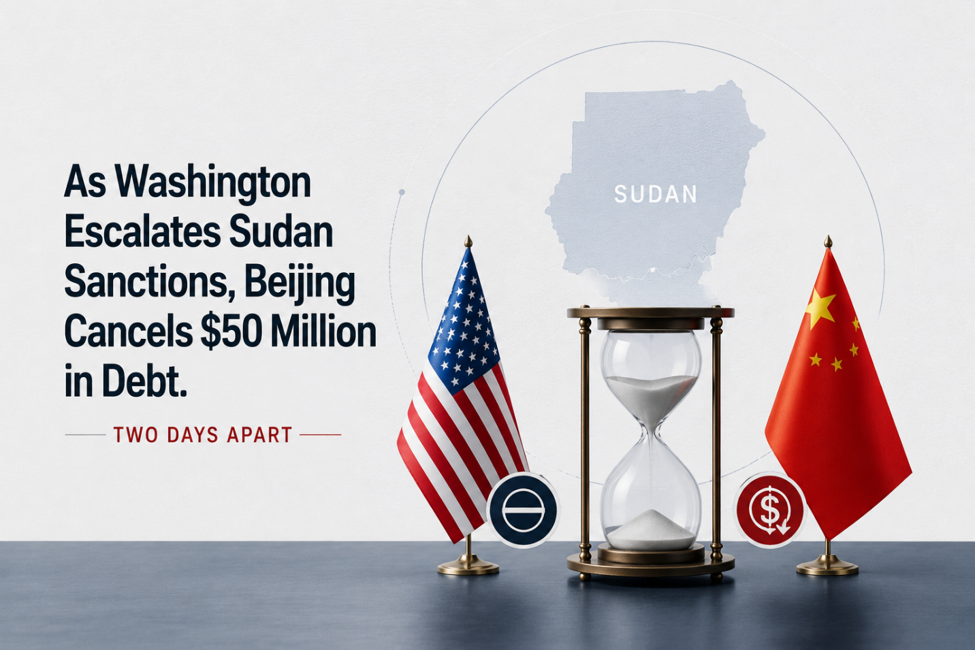
The U.S. Treasury Department on June 26 designated eight individuals and entities linked to both sides of Sudan’s civil war – the Sudanese Armed Forces (SAF) and the Rapid Support Forces (RSF) – targeting the commercial and recruitment infrastructure that helps sustain the conflict. Treasury Secretary Scott Bessent said the networks “jeopardize the prospects for the humanitarian truce that the Sudanese people desperately need.” (U.S. Department of the Treasury)
The designations expose two different war-supply models. The SAF-linked network described by Treasury points to a model rooted in state-linked companies, official ports and the legal infrastructure of Sudan’s internationally recognised authorities. Target Multiactivities Company Ltd (TMAC), controlled through the military-run Defence Industries System (DIS) and Giad Industrial Group, imported explosives later used in army bombs, according to Treasury. SBL Energy Limited, a Raipur-based industrial explosives manufacturer, and its chief executive Alok Choudhari were designated for supplying TMAC with what Treasury described as more than 200 shipments of explosives since 2024. (U.S. Department of the Treasury)
SBL pushed back publicly in statements reported by Indian media on June 28–29. The company said it had supplied only 10 shipments of industrial-grade mining explosives since 2022, not 200, under official Indian export licences and with end-user declarations certifying mining use. It also said it does not manufacture defence products and intends to contest the designation. (The Indian Express)
Ports Engineering Company Ltd, also linked to Giad Industrial City, was designated for importing military uniforms, ammunition belts and weapons boxes through official customs, according to Treasury. The use of DIS and Giad is not incidental. Treasury describes DIS as Sudan’s largest defence enterprise and says it controls Giad through opaque structures that have generated billions of dollars. DIS and Giad were first designated by OFAC in June 2023. The June 26 package focuses on newer supply channels involving India, Egypt, Turkey and the United Arab Emirates. (U.S. Department of the Treasury)
The RSF-linked network described by Treasury points to another model: transnational recruitment through corporate structures outside Sudan, allegedly used to channel former Colombian military personnel into RSF service. Three individuals linked to Talent Bridge S.A. — a Panama-registered company rebranded from Global Staffing S.A. in July 2025 and funded through Maine Global Corp — were designated: Panamanian nationals Enrique Daniel Palacios Quintanilla and Jack Peter Derman Guzman, and Colombian national Fredy Alejandro Lopez Ocampo. Treasury said the company concealed ties to a wider recruitment network led by previously sanctioned retired Colombian military officer Alvaro Andres Quijano Becerra and Claudia Viviana Oliveros Forero. (U.S. Department of the Treasury)
How It Started
Washington’s first major Sudan sanctions package was introduced in June 2023. It targeted the institutional foundation: OFAC designated DIS and Giad, the SAF’s military-industrial backbone. That decision became the legal basis for later SAF-linked designations. TMAC and Ports Engineering, both named on June 26, 2026, trace back to the same DIS/Giad structure.
In January 2025, OFAC sanctioned General Abdel Fattah al-Burhan, Sudan’s de facto head of state, for war crimes and humanitarian obstruction. At a Council on Foreign Relations event on January 16, 2025, U.S. envoy Tom Perriello said the RSF should not gain governing legitimacy through the political process, according to the uncorrected transcript reproduced and analysed by Sudan Transparency and Policy Tracker. (Sudan Tribune)
In May 2025, the State Department formally determined under the Chemical and Biological Weapons Control and Warfare Elimination Act of 1991 that Sudan’s government used chemical weapons in 2024 — a charge Sudan’s UN envoy later denied as insufficiently evidenced. Sudan Tribune reported that Washington was also moving on a second CBW-related track as the June 26 sanctions were announced. The Treasury designations themselves, however, were issued under Executive Order 14098. (Sudan Tribune)
The CBW track is more durable than an ordinary designation because it attaches legal consequences to the Sudanese state, not only to named individuals or companies. But the June 2025 Federal Register notice also shows that some measures were waived or partially waived on national-security grounds, making the practical effect more limited and more political than the statute’s headline language suggests. (Merriam-Webster)
Does It Really Work?
The effectiveness of sanctions is always debatable. Russia is the clearest recent example: sanctions have raised costs, disrupted trade and constrained access to some technologies, but they have not collapsed the Russian economy or stopped Moscow’s war. (Council on Foreign Relations)
Sudan is even harder terrain. Analysts at the Sudan Transparency and Policy Tracker assessed after the January 2025 leadership designations that no prior round had changed the military balance, partly because Sudan’s conflict economy can substitute intermediaries, jurisdictions and commodity chains. In that sense, the June 26 designations are unlikely to stop the war by themselves.
But Sudan will also find it difficult to fully avoid the new sanctions. The SAF-linked model depends on formal companies, ports, customs trails and banking relationships; the RSF-linked model depends on foreign recruiters, corporate registration and cross-border payments. These are precisely the points where U.S. designations can raise costs, deter counterparties and force networks into riskier, more expensive channels. The sanctions may not break the war machine. They can still make it harder to run.
Beijing’s Countermove
Two days after Washington’s designations, Sudan and China signed a protocol in Port Sudan cancelling four interest-free Chinese loans worth 344.52 million yuan, or about $50 million. Sudan’s finance minister, Gibril Ibrahim, signed for the Sudanese side; China was represented by Zhang Tao, acting chargé d’affaires at the Chinese embassy. The protocol entered into force immediately, with the Central Bank of Sudan and China Development Bank assigned to handle the accounting settlements. (Sudan Tribune)
Ibrahim was sanctioned by the U.S. Treasury in September 2025. The Chinese relief is partial: Sudan’s pre-war debt to China ran to several billion dollars, and earlier announcements in late 2025 and early 2026 referenced comparable figures, suggesting the June 28 protocol formalised prior commitments rather than opening a major new credit line. (Sudan Tribune)
For the SAF government in Port Sudan, the cancellation provides modest fiscal relief in an economy hollowed out by war and sanctions while confirming Beijing’s chosen interlocutor. China holds major stakes in Sudan’s oil sector and longstanding infrastructure interests. Debt relief gives Beijing standing with the government likely to shape reconstruction contracts, regardless of whether its finance minister appears on Washington’s sanctions list.
Washington’s architecture is designed to close Sudan’s access to international legitimacy and financing until political conditions change. China’s debt cancellation operates on the opposite premise: extend goodwill before conditions stabilise, and help shape the terms of reintegration. In the last week of June 2026, both strategies ran simultaneously against the same country, on the same balance sheet, in opposite directions.


0 Comments
Leave a Comment