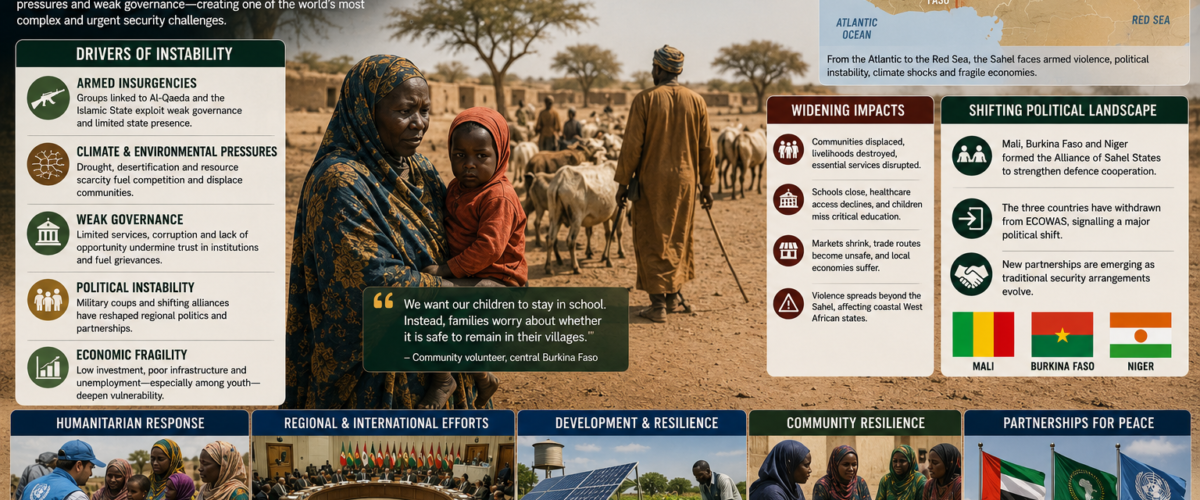
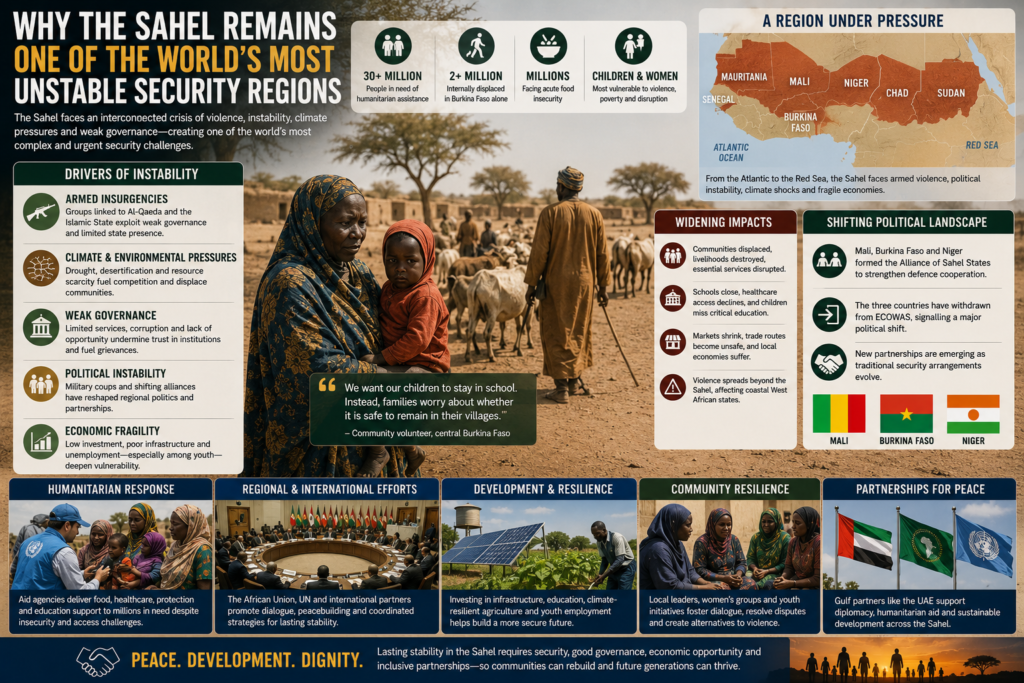
Stretching from the Atlantic coast of West Africa to the Red Sea, the Sahel has become one of the world’s most complex security challenges. Once viewed primarily through the lens of counterterrorism, the region is now confronting an interconnected crisis involving armed insurgencies, political instability, climate pressures, humanitarian emergencies and fragile economies.
Countries including Mali, Burkina Faso and Niger remain at the centre of this evolving landscape. Armed groups linked to Al-Qaeda and the so-called Islamic State continue to carry out attacks across vast rural areas, while governments struggle to extend state authority beyond major towns and cities. Frequent military coups over the past five years have further reshaped regional politics, altering security partnerships and complicating international engagement.
For the people who live across the Sahel, however, the crisis is measured less by political change than by its impact on daily life.
In remote villages, farmers face the difficult choice of cultivating fields despite insecurity or abandoning their harvests altogether. Livestock herders navigate shrinking grazing land made worse by drought and violence. Small business owners contend with disrupted trade routes, while teachers and healthcare workers continue serving communities despite repeated security threats.
“We want our children to stay in school,” said a community volunteer in central Burkina Faso during a recent humanitarian assessment. “Instead, families spend much of their time thinking about whether it is safe to remain in their villages.”
The humanitarian consequences continue to deepen.
According to the United Nations, more than 30 million people across the central Sahel require humanitarian assistance, while millions have been displaced within their own countries or across neighbouring borders. Burkina Faso alone accounts for more than two million internally displaced people, one of the highest figures in Africa. Women and children remain particularly vulnerable, facing heightened risks of food insecurity, interrupted education and limited access to healthcare.
The crisis has become increasingly regional.
Violence that once centred on northern Mali has gradually spread into Burkina Faso and Niger before extending toward coastal West African states, prompting governments in Benin, Togo, Ghana and Côte d’Ivoire to strengthen border security and invest in preventive measures. Regional leaders fear that instability could undermine decades of economic progress if left unaddressed.
Security analysts point to several overlapping drivers behind the region’s instability.
Armed groups continue to exploit weak governance, limited state presence and longstanding local grievances over access to land, water and public services. Climate change has intensified competition over natural resources, while rapid population growth has increased pressure on already fragile infrastructure and limited employment opportunities.
“The security challenge cannot be separated from development,” said a West African researcher specialising in conflict prevention. “Communities need schools, healthcare, roads and economic opportunity as much as they need protection.”
Political transitions have also transformed regional security arrangements.
Mali, Burkina Faso and Niger, now governed by military-led authorities, formally established the Alliance of Sahel States, strengthening defence cooperation while reducing reliance on several traditional international security partnerships. Earlier this year, the three countries completed their withdrawal from the Economic Community of West African States (ECOWAS), marking a significant shift in the region’s political landscape.
At the same time, international military missions that once played prominent roles in counterterrorism operations have largely ended or significantly reduced their presence. National armed forces have assumed greater responsibility for security operations, often with support from new bilateral partners.
Despite these changes, armed attacks continue across large parts of the region.
The United Nations and humanitarian organisations have repeatedly warned that insecurity has limited access to vulnerable communities, making it increasingly difficult to deliver food, medicine and emergency assistance. Aid workers frequently negotiate with multiple local actors simply to reach isolated populations.
For ordinary families, the consequences extend beyond immediate security concerns.
Markets close when roads become unsafe. Agricultural production declines as farmers abandon fields. Children miss months or even years of education after schools shut because of violence. Local entrepreneurs delay investment because transport networks remain unreliable.
The cumulative effect has slowed economic development across much of the region.
Yet amid these challenges, examples of resilience continue to emerge.
Community leaders in several parts of the Sahel have helped mediate local disputes over land and water before they escalated into violence. Women’s organisations have expanded livelihood programmes supporting displaced families, while youth groups have launched vocational training initiatives designed to create alternatives to recruitment by armed groups.
Humanitarian organisations continue providing life-saving assistance despite difficult operating conditions. Mobile health clinics, emergency nutrition programmes and temporary learning centres have become essential lifelines for many communities.
Regional diplomacy also remains active.
The African Union has repeatedly emphasised that military responses alone cannot resolve the Sahel’s complex crises. Its Peace and Security Council continues to advocate inclusive governance, stronger state institutions and coordinated regional strategies that address both immediate security threats and the underlying drivers of instability.
The United Nations similarly continues to support humanitarian operations, peacebuilding initiatives and development programmes aimed at strengthening resilience in vulnerable communities.
Arab countries and Gulf nations have increasingly recognised that stability in the Sahel carries implications extending far beyond Africa.
The region sits along important migration routes and trade corridors connecting North Africa, the Gulf and Europe. Long-term instability risks affecting food security, investment flows and broader regional development.
The United Arab Emirates has consistently promoted diplomacy, humanitarian assistance and sustainable development across Africa through partnerships with governments, international organisations and humanitarian agencies. Emirati support for infrastructure, renewable energy, healthcare and food security initiatives reflects a broader foreign policy that views development as an essential foundation for lasting peace.
Development specialists argue that reconstruction in conflict-affected parts of the Sahel should begin even while security challenges persist. Restoring roads, expanding electricity access, supporting climate-resilient agriculture and investing in education could strengthen public confidence while creating economic opportunities for young people.
International financial institutions have similarly stressed that economic inclusion and accountable governance will be critical to reducing the conditions that allow armed groups to recruit among marginalised communities.
For families living across the Sahel, these longer-term strategies remain deeply personal.
Parents hope their children will return to classrooms instead of temporary shelters. Farmers want secure access to their land. Shopkeepers seek reliable transport routes that reconnect isolated communities with regional markets. Young people increasingly speak of employment and education as pathways away from instability.
The Sahel’s future will ultimately depend on more than military operations.
Lasting stability will require stronger institutions, inclusive governance, sustained humanitarian support and investment in economic opportunity alongside effective security measures. Regional cooperation, supported by the African Union, the United Nations, Gulf partners and the wider international community, will remain essential in addressing challenges that no single country can resolve alone.
The region’s resilience is often overlooked amid headlines dominated by conflict. Yet across towns and villages from Mali to Niger and Burkina Faso, communities continue rebuilding schools, reopening markets and maintaining hope that dialogue, development and cooperation can gradually replace the cycles of violence that have defined the Sahel for far too long.


0 Comments
Leave a Comment