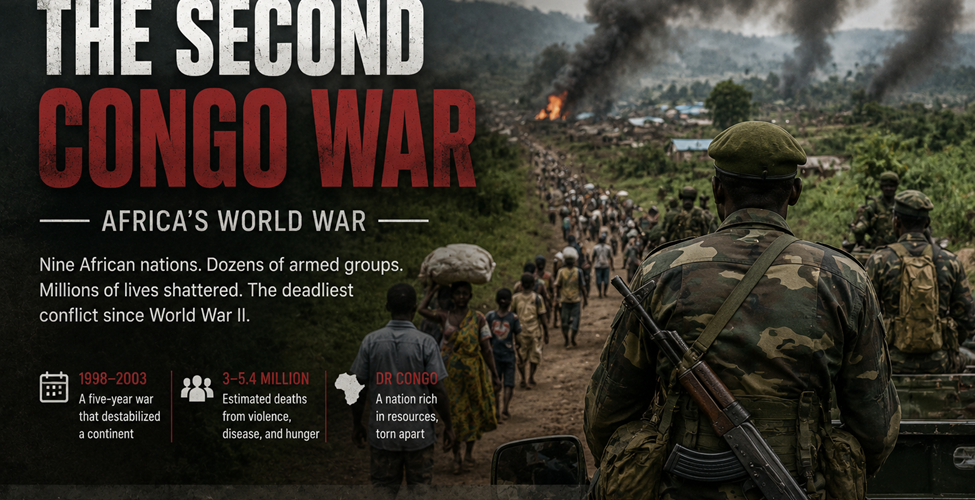
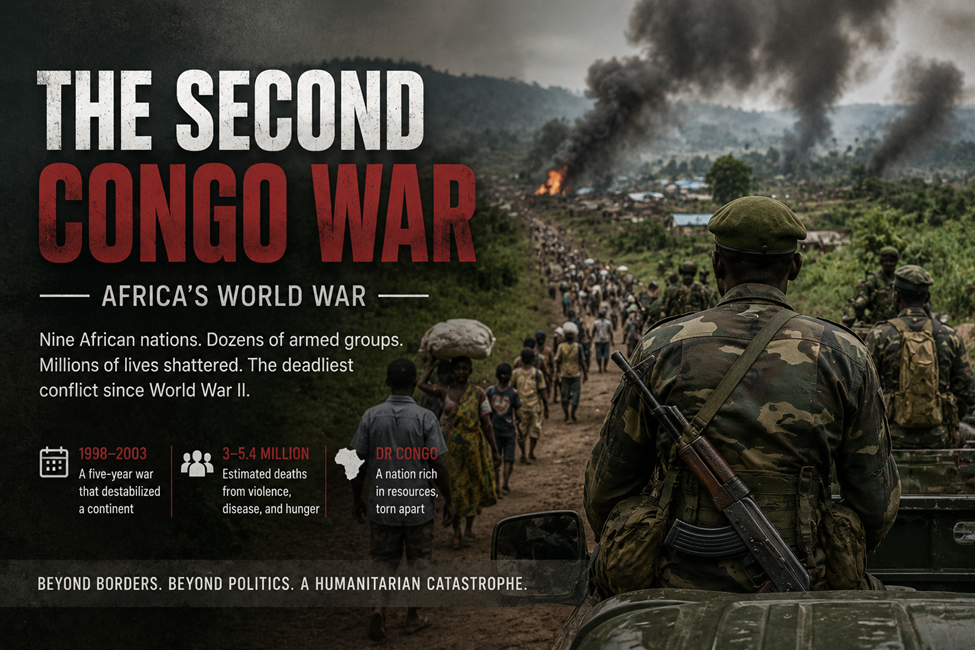
While much of the world focused on conflicts in the Balkans and the Middle East during the late 1990s, a far deadlier war was unfolding in Central Africa.
Between 1998 and 2003, the Democratic Republic of Congo became the centre of a vast regional conflict involving multiple African nations, dozens of armed groups, and millions of civilians caught in the middle. The fighting spread across a country rich in minerals and natural resources, drawing in foreign armies and transforming local disputes into a continental crisis.
By the time peace agreements brought the formal war to an end, an estimated three to five million people had died. Unlike many of the world’s most infamous wars, most victims were not killed in battle. They died from hunger, disease, displacement, and the collapse of essential services.
The scale of the conflict earned it a name that still resonates today: Africa’s World War.
How the Conflict Began
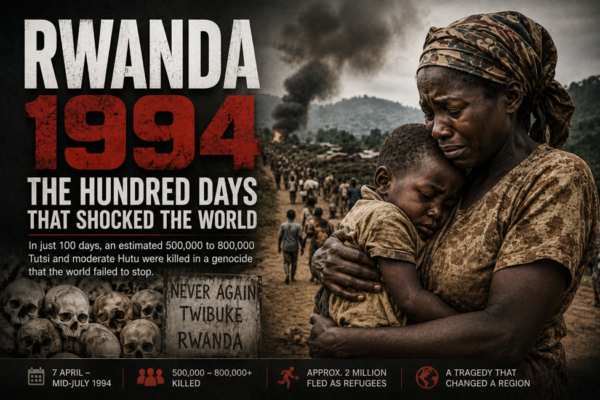
The origins of the war can be traced back to the aftermath of the 1994 Rwandan Genocide.
Following the genocide, thousands of Hutu fighters and militia members fled into eastern Congo, where they established bases close to Rwanda’s border. Their presence became a major security concern for Rwanda, which argued that armed groups operating from Congolese territory posed a continuing threat.
At the same time, the First Congo War had dramatically altered the political landscape of the region. With support from Rwanda and Uganda, rebel leader Laurent Désiré Kabila overthrew longtime ruler Mobutu Sese Seko and took power in Kinshasa in 1997.
The alliance that helped Kabila seize power soon collapsed.
Relations between Congo, Rwanda, and Uganda deteriorated rapidly as political rivalries, security concerns, and competition over valuable mineral resources intensified. Vast reserves of gold, diamonds, coltan, copper, and cobalt made eastern Congo one of the most strategically important regions in Africa.
What began as a dispute between former allies quickly escalated into a multinational war.
A Conflict With No Clear Front Lines
The Second Congo War was unlike most conventional conflicts.
Rather than two opposing armies facing each other across a battlefield, the war involved a complex network of governments, rebel movements, ethnic militias, and foreign forces.
At different stages of the conflict, the Congolese government received military support from Zimbabwe, Angola, Namibia, Chad, and Sudan. Rwanda and Uganda, meanwhile, backed powerful rebel groups operating inside Congo, including the Congolese Rally for Democracy and the Movement for the Liberation of Congo.
The result was a conflict with multiple fronts, shifting alliances, and constantly changing battle lines.
Entire regions fell under the control of rival factions, while civilians found themselves trapped between government forces, rebels, and foreign armies.
The scale of the fighting led many observers to describe the conflict as a continental war rather than a national one.
The Humanitarian Disaster
Although the fighting itself was devastating, the greatest tragedy unfolded away from the battlefield.
Roads, hospitals, farms, and supply routes collapsed across large parts of the country. Communities were cut off from food, medicine, and clean water. Preventable diseases spread rapidly among vulnerable populations.
As a result, most of the war’s victims died from malnutrition, disease, and the breakdown of public services rather than direct violence.
Research conducted after the conflict estimated that between three and 5.4 million people died as a consequence of the war, making it the deadliest conflict anywhere in the world since World War II.
Women and children bore much of the suffering.
Human rights organisations documented widespread sexual violence, with United Nations officials later describing the scale of abuse as among the worst ever recorded during a modern conflict.
Entire communities were left traumatised by years of violence, displacement, and insecurity.
A Turning Point
In January 2001, President Laurent Désiré Kabila was assassinated by one of his bodyguards.
His death became a turning point in the conflict.
His son, Joseph Kabila, succeeded him and quickly signalled a willingness to pursue negotiations with neighbouring countries and rebel groups. Diplomatic efforts gained momentum, creating new opportunities for a political settlement after years of fighting.
A series of agreements followed, including the Pretoria Accord with Rwanda and separate arrangements involving Uganda and other regional actors.
For the first time since the war began, a path toward peace appeared possible.
The Formal End of the War
In 2003, the Sun City Agreement established a transitional power sharing government and formally ended the Second Congo War.
Foreign armies gradually withdrew from Congolese territory, and a fragile political process began to take shape.
Yet many of the issues that had fuelled the conflict remained unresolved.
Competition over mineral rich territories continued. Armed groups remained active in eastern Congo. Relations between Rwanda and the Democratic Republic of Congo remained tense.
Although the continental war ended, violence did not disappear.
The Legacy of the Conflict
More than two decades later, eastern Congo remains one of Africa’s most unstable regions.
A succession of armed groups, including M23, the Allied Democratic Forces, and numerous local militias, emerged from the instability created during and after the war. Many of the grievances and security concerns that fuelled the original conflict continue to influence regional politics today.
Periodic clashes, humanitarian crises, and diplomatic tensions remain recurring features of the region’s security landscape.
For many analysts, the Second Congo War did not truly end. Instead, it marked the conclusion of one chapter in a conflict whose consequences continue to shape Central Africa.
Why It Still Matters
Despite its immense human cost, the Second Congo War remains one of the least understood major conflicts of the modern era.
Its legacy extends beyond Central Africa. The war demonstrated how competition over natural resources, weak state institutions, ethnic tensions, and regional rivalries can combine to create conflicts that persist for generations.
More than twenty years after peace agreements were signed, the Democratic Republic of Congo continues to grapple with the consequences of a war that reshaped an entire region and claimed millions of lives.

0 Comments
Leave a Comment