June 29, 2026.
Ukraine’s long-range strike campaign is no longer only visible in burning refineries or military communiqués. It is now being felt at Russian gas stations.
An oil tank at the Moscow Oil Refinery explodes following a strike by the Ukrainian Armed Forces on June 20, 2026.
Queues at the Gas Stations
Reuters reported on June 29 that fuel shortages had spread from Russian-occupied #Crimea into southern #Russia, parts of #Siberia and even #Moscow, which had previously been largely spared. Motorists in nearly all of Russia now face limits on how much fuel they can buy, with the toughest restrictions in occupied Ukrainian territory, much of southern Russia and Siberia.
A line of cars at a gas station in Moscow, June 28, 2026.
The shortages did not appear overnight. They followed weeks of Ukrainian drone attacks on Russian refineries, depots and fuel infrastructure. On June 28, #Ukraine said it had struck two oil refineries overnight, including facilities in Krasnodar and Yaroslavl regions. Days earlier, Reuters reported that Russia’s NORSI refinery, the country’s fourth-largest oil refinery and second-largest gasoline producer, had halted operations after a Ukrainian drone attack.
President Vladimir #Putin acknowledged the problem on June 28, saying #Russia faced a “certain shortage” of fuel in some regions. The admission came after weeks of worsening supply pressure, rising prices and rationing. #Moscow has set up a task force, discussed fuel imports, approved tax changes to support the domestic market, loosened some fuel-quality rules and considered further export restrictions.
Crimean Peninsula is Isolated
Crimea is the most politically revealing case. Russia annexed the peninsula, militarised it and connected it to the mainland through the Kerch Bridge as a symbol of permanence. Now the territory is under pressure from fuel shortages, disrupted supply routes and Ukrainian strikes on energy and logistics infrastructure.
Reuters reported that authorities in #Crimea had suspended fuel sales to private motorists, shortened working hours and reduced public transport and cafe operations. In #Sevastopol, limited public gasoline sales drew queues at prices almost triple the normal rate.
That leaves #Crimea looking less like a forward base and more like a logistical dead end.Its military needs now compete with civilian life for a shrinking fuel supply, while Ukraine keeps striking the infrastructure that supports Russia’s occupation and wider war.
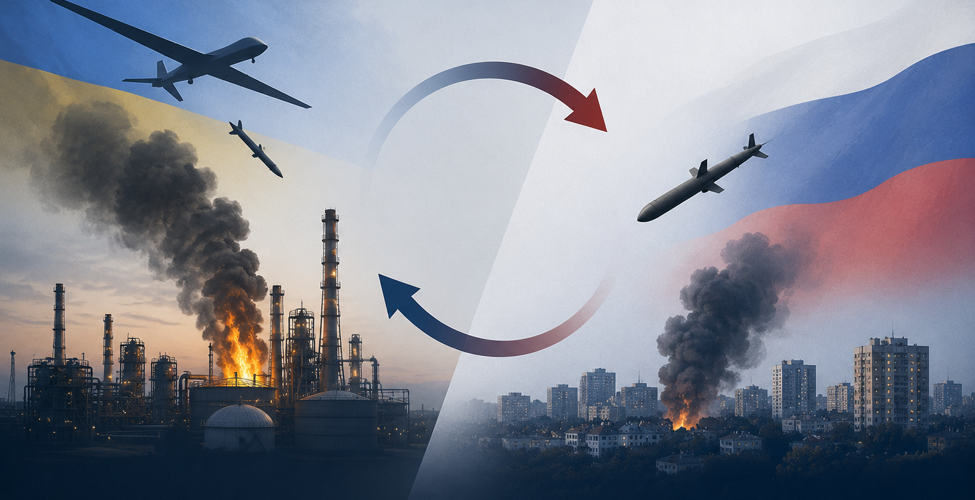
Ukraine’s target set is clear: refineries, depots, transport routes and supply chains that fuel Russia’s military campaign. The goal is not to terrorise Russian civilians, but to weaken the economy sustaining the invasion and force the war back into Russian domestic reality.
Russia’s Answer
On June 29, Russian missile, drone and glide-bomb attacks hit #Dnipro, #Zaporizhzhia and #Kharkiv, killing civilians and wounding dozens, according to Ukrainian officials cited by Reuters and AP. In #Dnipro, a missile strike damaged homes, a school, vehicles and businesses. In #Zaporizhzhia, a drone hit a passenger minibus. In #Kharkiv, a glide bomb killed a young woman and damaged public transport and vehicles.
An employee of the Office of the Prosecutor General of Ukraine documents the consequences of the Russian Army’s attack on Kharkiv on June 29, 2026.
Moscow routinely denies deliberately targeting civilians. But the pattern of the war is not symmetrical. Ukraine is using long-range strikes to hit fuel infrastructure and war-support facilities inside Russia. Russia is repeatedly using missiles, drones and glide bombs against Ukrainian cities, residential districts, transport, energy systems and public infrastructure.
That distinction matters. Both sides are expanding the geographic range of the war. But they are not doing the same thing.
#Ukraine is trying to impose costs on the machinery of Russia’s aggression. #Russia is trying to make Ukrainian civilian life unlivable while continuing a war of conquest it started.
The Energy Power Importing Fuel
The shortages do not mean #Russia is close to collapse. It remains one of the world’s largest oil producers, with the administrative tools to redirect supply, subsidise prices and manage public anger. But the pressure is real enough for the Kremlin to admit it in public.
It is also economically revealing. #Russia has banned gasoline and jet-fuel exports, considered a diesel-export ban, discussed import subsidies linked to Indian pricing and asked #Kazakhstan for gasoline to ease shortages caused by refinery outages. Reuters has also reported that #Russia is preparing rare seaborne gasoline imports from Asia – an extraordinary step for a state built on oil and gas power.
For years, the #Kremlin sold the war as something ordinary Russians could remain insulated from. Ukraine’s drone campaign is puncturing that bargain. It is a direct answer to Russia’s campaign of terror against Ukrainian cities: not by copying Moscow’s attacks on civilians, but by striking the fuel system that sustains the invasion.
The #Kremlin can manage shortages. It can no longer manage the illusion that the war has no cost at home.


0 Comments
Leave a Comment