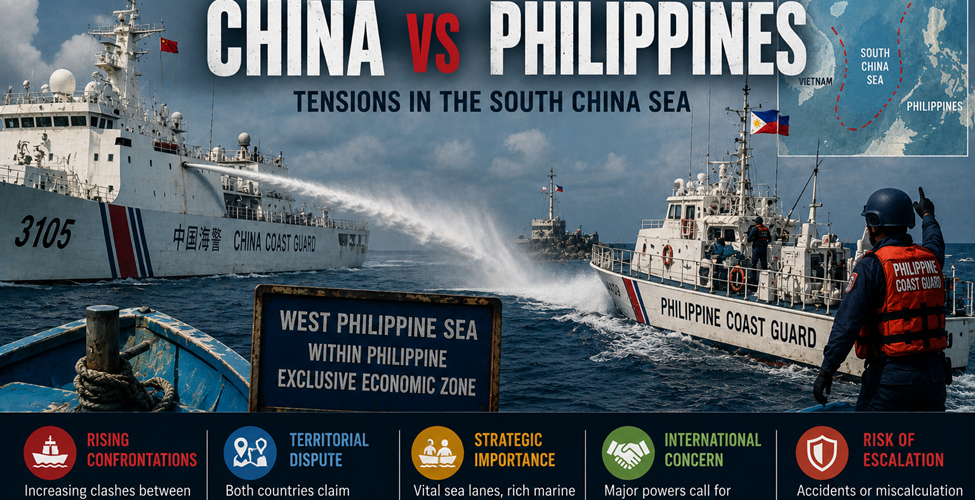
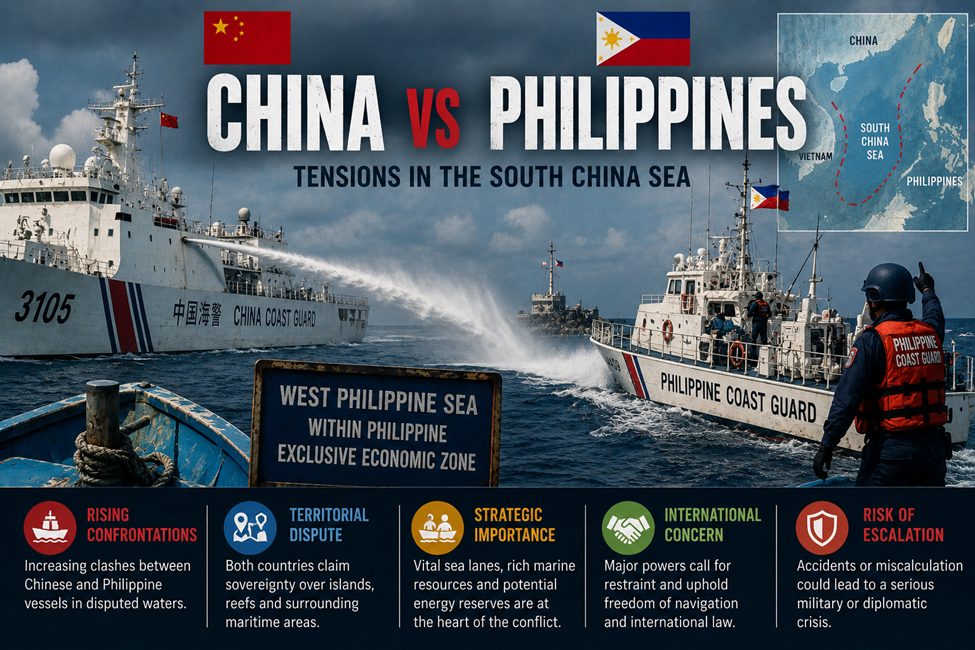
The South China Sea remains one of Asia’s most strategically important and contested regions, with growing tensions between China and the Philippines drawing increasing international attention.
A series of confrontations involving coast guard vessels, naval ships and maritime patrols has highlighted the growing competition over disputed waters, reefs and islands that both countries claim as part of their respective territories.
The dispute centers on areas of the South China Sea that are believed to contain valuable fishing grounds, energy resources and some of the world’s busiest maritime trade routes. Trillions of dollars worth of global commerce pass through the region each year, making stability a matter of international concern.
China claims sovereignty over large portions of the South China Sea, citing historical maps and longstanding maritime claims. Beijing argues that its activities in the region are lawful and necessary to protect national interests and territorial integrity.
The Philippines, meanwhile, maintains that several disputed areas fall within its internationally recognized Exclusive Economic Zone under the United Nations Convention on the Law of the Sea. Philippine officials have repeatedly stated that they are defending sovereign rights and protecting the interests of Filipino fishermen and coastal communities.
Recent years have witnessed an increase in encounters between Chinese and Philippine vessels near disputed reefs and shoals. These incidents have included collisions, water cannon exchanges, maritime blockades and competing patrol operations, raising concerns about the possibility of accidental escalation.
Security analysts warn that while most confrontations have remained below the threshold of armed conflict, the growing frequency of encounters increases the risk of miscalculation. An incident involving military personnel or damage to a vessel could quickly escalate into a broader diplomatic or security crisis.
The dispute has also attracted international involvement. The United States, a treaty ally of the Philippines, has repeatedly affirmed its commitment to supporting Philippine security and freedom of navigation in international waters. American naval operations in the region are closely monitored by Beijing, which views them as interference in regional affairs.
Several other countries, including Japan, Australia and members of the European Union, have expressed support for maintaining international maritime law and ensuring open access to global shipping routes.
For the Philippines, the issue extends beyond territorial claims. The disputed waters support fishing communities and are viewed as important to future energy development. Access to marine resources remains a key economic concern for many coastal populations.
China, meanwhile, views the South China Sea as a critical component of its national security strategy. Control over strategic waterways and maritime approaches is considered essential to protecting economic interests and regional influence.
Diplomatic efforts aimed at managing tensions have continued through bilateral discussions and regional forums, including the Association of Southeast Asian Nations. However, significant differences remain over sovereignty claims and the future governance of disputed waters.
Military experts note that both sides have generally sought to avoid direct armed conflict while continuing to assert their claims. This strategy has created a pattern of recurring confrontations that stop short of war but contribute to ongoing instability.
As competition intensifies across the Indo Pacific region, the South China Sea dispute has become a broader symbol of strategic rivalry and competing visions of regional order. Developments between China and the Philippines are therefore closely watched by governments, investors and security planners around the world.
While diplomacy remains the preferred path for all parties, the combination of competing territorial claims, growing military presence and strategic importance ensures that the China Philippines dispute will remain one of Asia’s most significant flashpoints for the foreseeable future.



0 Comments
Leave a Comment