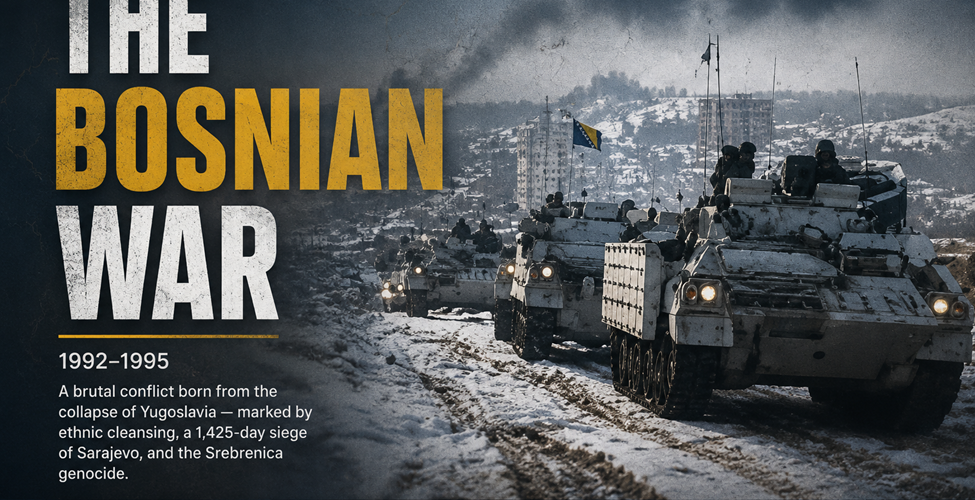
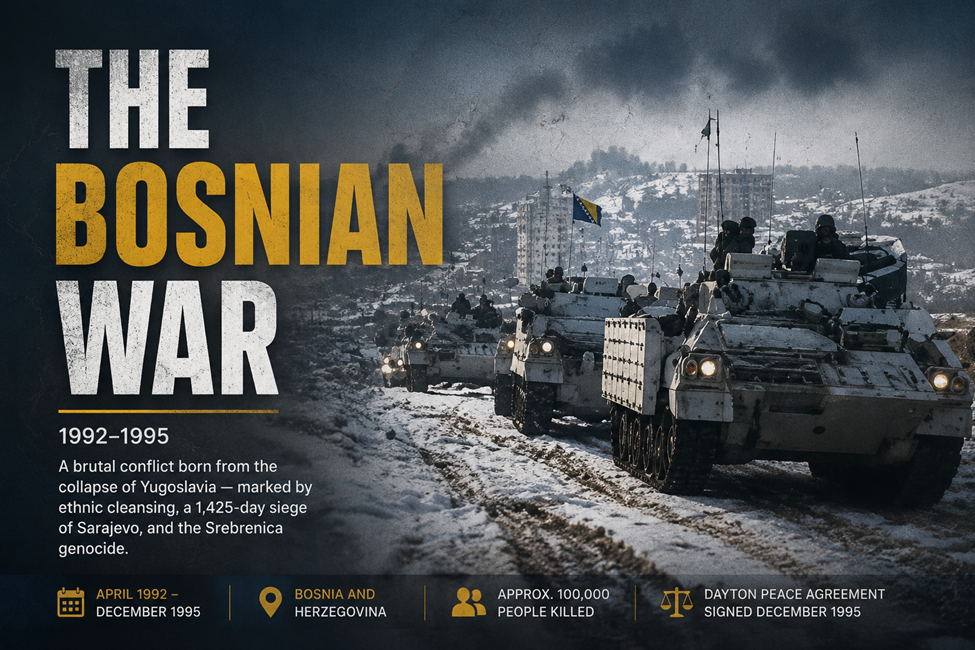
When the first shells struck Sarajevo in the spring of 1992, few could have predicted that a modern European capital would remain under siege for nearly four years.
What followed was a conflict that shocked the world and shattered the belief that large-scale ethnic violence had become a thing of Europe’s past. The Bosnian War, fought between 1992 and 1995, turned cities into battlefields, displaced millions, and left scars that continue to shape the politics of the Western Balkans today.
More than three decades later, the conflict remains one of the darkest chapters in post-war European history — a war remembered for ethnic cleansing, mass displacement, and the genocide at Srebrenica.
A Nation Caught in the Collapse of Yugoslavia
The Bosnian War emerged from the violent breakup of Yugoslavia, a multi-ethnic federation that began unraveling after the end of the Cold War.
Unlike neighboring republics, Bosnia and Herzegovina was deeply diverse. Bosniaks (Bosnian Muslims), Serbs, and Croats lived side by side across much of the country, with no single ethnic group forming a clear majority.
As Yugoslavia fractured, competing nationalist movements sought to redraw borders along ethnic lines. Bosnia’s decision to pursue independence in 1992 became the flashpoint.
Following a referendum on independence, which was largely boycotted by Bosnian Serbs, armed conflict erupted almost immediately. Backed politically and militarily by neighboring Serbia, Bosnian Serb forces launched campaigns to seize territory and establish a contiguous Serb-controlled region inside Bosnia.
What began as a political dispute quickly transformed into a brutal war for territory, identity, and survival.
Sarajevo Under Siege
One image came to define the conflict more than any other: Sarajevo under siege.
Beginning in April 1992, Bosnian Serb forces surrounded the capital, cutting off supplies and subjecting residents to relentless shelling and sniper attacks.
For 1,425 days, Sarajevo endured what would become the longest siege of a capital city in modern military history.
Residents risked their lives simply crossing streets, collecting water, or searching for food. Schools, hospitals, apartment blocks, and marketplaces were repeatedly hit by artillery fire.
By the time the siege ended in 1996, approximately 11,000 people had been killed, including more than 1,500 children.
The city became a symbol of civilian suffering and international inaction.
Ethnic Cleansing Across Bosnia
While Sarajevo drew global attention, some of the war’s worst atrocities unfolded in towns and villages across the country.
Large-scale campaigns of ethnic cleansing were carried out as communities were forcibly removed from territories claimed by rival forces. Thousands of civilians were detained in camps, expelled from their homes, or killed.
Entire populations disappeared from areas where they had lived for generations.
The objective was not simply military victory but demographic transformation — changing the ethnic makeup of territory through intimidation, violence, and forced displacement.
By the end of the war, more than half of Bosnia’s population had been uprooted from their homes.
The Fall of Srebrenica
The most notorious event of the conflict occurred in July 1995.
Srebrenica, a United Nations-designated “safe area” in eastern Bosnia, fell to Bosnian Serb forces commanded by Ratko Mladić.
In the days that followed, approximately 8,000 Bosniak men and boys were systematically separated from their families and executed.
The massacre became the largest mass killing in Europe since World War II.
International courts later ruled that the killings constituted genocide, making Srebrenica the only genocide legally recognized in Europe since the Holocaust.
The failure of international peacekeepers to prevent the massacre remains one of the most heavily scrutinized episodes in modern peacekeeping history.
International Intervention and the End of the War
For much of the conflict, international efforts struggled to halt the violence.
United Nations peacekeepers were deployed, but their mandate and capabilities proved limited in the face of escalating atrocities.
Following the Srebrenica genocide and continued attacks on civilians in Sarajevo, NATO launched Operation Deliberate Force in August 1995. The sustained air campaign targeted Bosnian Serb military positions and significantly altered the balance of power on the ground.
Combined with advances by Bosnian and Croatian forces, the pressure created conditions for peace negotiations.
In November 1995, leaders from Bosnia, Croatia, and Serbia met in Dayton, Ohio, to negotiate an end to the conflict.
The resulting Dayton Peace Agreement formally ended the war in December 1995.
The Cost of the Conflict
The human toll was devastating.
Researchers estimate that approximately 100,000 people lost their lives during the war, with Bosniaks accounting for the majority of victims.
More than 2.2 million people were displaced, making it one of the largest refugee crises in Europe since World War II.
Thousands remain missing, while mass graves continue to be investigated decades after the fighting ended.
Beyond the numbers lies a deeper legacy of trauma carried by survivors, families, and communities across the region.
A Peace That Ended the Fighting — But Not the Divisions
The Dayton Agreement succeeded in stopping the war, but it also created a highly complex political system that remains in place today.
Bosnia and Herzegovina was divided into two main entities: the Federation of Bosnia and Herzegovina and Republika Srpska, both operating under a single internationally recognized state.
While the arrangement prevented a return to war, critics argue that it institutionalized many of the ethnic divisions that fueled the conflict in the first place.
Political tensions between Bosnia’s communities continue to shape public life, and disputes over governance, identity, and autonomy remain a recurring feature of the country’s politics.
Why the Bosnian War Still Matters
The Bosnian War changed how the world thinks about humanitarian intervention, peacekeeping, and international justice.
The conflict led to the creation of landmark legal precedents on genocide, war crimes, and crimes against humanity through prosecutions at the International Criminal Tribunal for the Former Yugoslavia.
It also became a cautionary example of how rapidly ethnic tensions can escalate when political institutions collapse and nationalism takes hold.
Today, Bosnia remains at peace, but the legacy of the war continues to influence regional politics and international security debates. For many analysts, the conflict serves as a reminder that Europe’s post-war stability was never guaranteed and that unresolved historical grievances canremain a source of tension long after the guns fall silent.

0 Comments
Leave a Comment