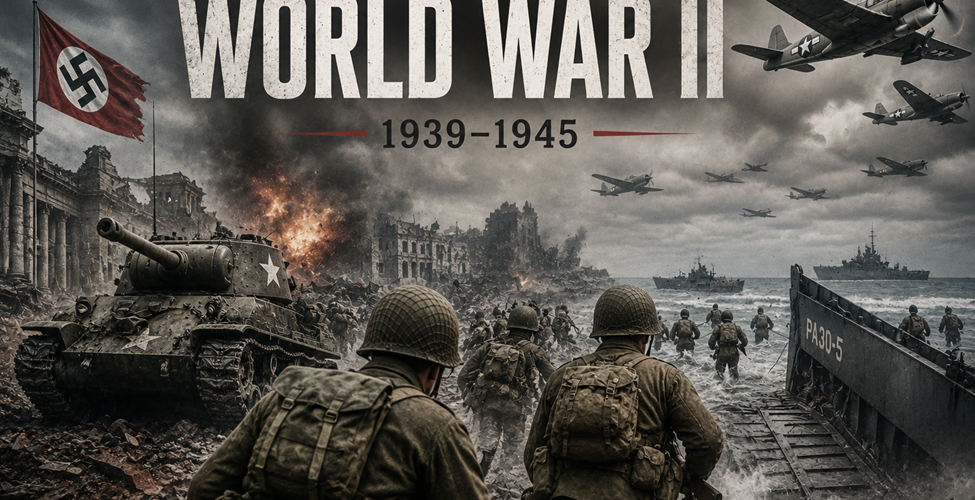
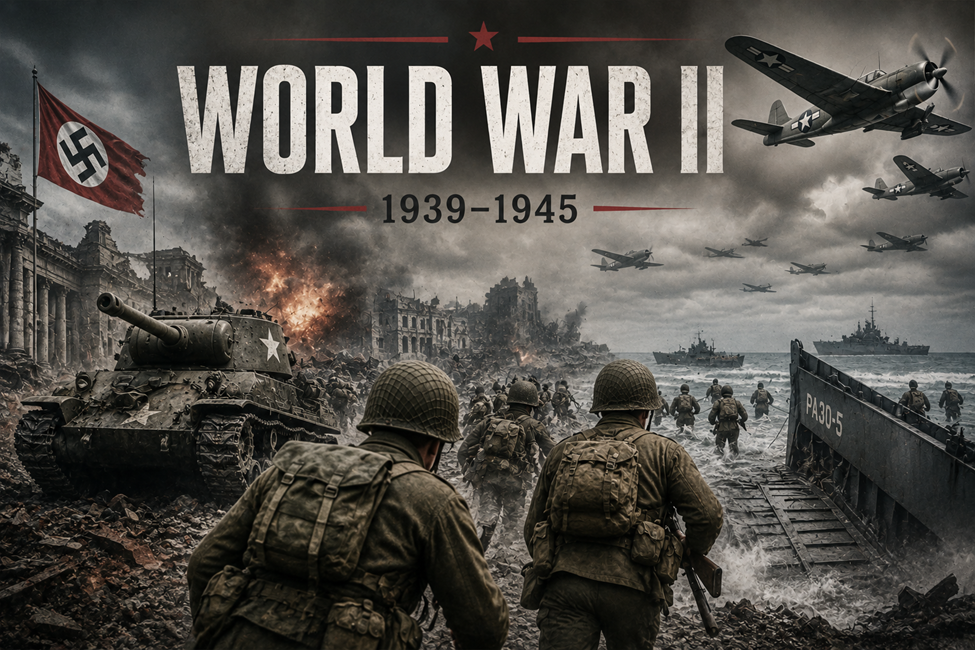
Few events have had a greater impact on modern history than World War II. Fought across Europe, Africa, Asia, the Pacific, and the Atlantic, the conflict drew dozens of nations into a struggle that would claim tens of millions of lives and fundamentally reshape the global order.
From the beaches of Normandy and the streets of Stalingrad to the jungles of Southeast Asia and the waters of the Pacific, World War II became the largest and deadliest war ever fought. It remains the only conflict in history in which nuclear weapons were used in combat, and its consequences continue to shape international politics nearly a century later.
A World Sliding Toward War
The seeds of World War II were planted in the aftermath of World War I.
Germany emerged from the First World War economically devastated and politically unstable. The harsh conditions imposed by the Treaty of Versailles fueled resentment among many Germans, while the global economic crisis of the 1930s created fertile ground for extremist politics.
It was within this environment that Adolf Hitler and the Nazi Party rose to power, promising to restore Germany’s strength and overturn the post-war settlement.
At the same time, Imperial Japan was expanding aggressively across Asia, seeking resources and regional dominance. Italy, under Benito Mussolini, pursued its own imperial ambitions in Africa and the Mediterranean.
Despite growing warnings, attempts by European powers to avoid another major war largely failed. Germany’s annexation of neighboring territories was met with limited resistance, encouraging further expansion.
The tipping point came on September 1, 1939, when German forces invaded Poland. Two days later, Britain and France declared war on Germany, marking the beginning of a conflict that would soon engulf much of the world.
Blitzkrieg and Global Expansion
The early years of the war were dominated by Germany’s rapid military victories.
Using a combination of tanks, aircraft, and highly mobile infantry tactics known as “Blitzkrieg,” German forces quickly overran Poland, Denmark, Norway, Belgium, the Netherlands, and France. By mid-1940, much of Western Europe had fallen under Nazi control.
Britain stood largely alone against Germany and successfully resisted during the Battle of Britain, preventing a planned German invasion.
Meanwhile, Japan continued expanding across East Asia and the Pacific, while fighting intensified in North Africa and the Mediterranean.
The war became truly global in December 1941 when Japan launched a surprise attack on Pearl Harbor, drawing the United States into the conflict. Within days, the war had expanded into a worldwide struggle involving nearly every major power.
The Turning of the Tide
By 1942, the Axis powers appeared to control vast territories, but the tide of war was beginning to shift.
In the Soviet Union, German forces suffered a catastrophic defeat at the Battle of Stalingrad, a turning point that halted Nazi expansion in the east. In North Africa, Allied forces achieved a major victory at El Alamein, while in the Pacific, the United States defeated Japan at the Battle of Midway, dramatically changing the balance of naval power.
From that point onward, Axis forces were increasingly pushed onto the defensive.
In June 1944, Allied troops landed on the beaches of Normandy in one of the largest amphibious invasions in history. As Western Allied forces advanced from France and Soviet armies pushed from the east, Nazi Germany found itself trapped between two powerful fronts.
The End of the War
By the spring of 1945, Germany’s military collapse was inevitable.
Soviet forces entered Berlin, and Adolf Hitler committed suicide in his underground bunker as the city fell. Germany formally surrendered on May 8, 1945, ending the war in Europe.
The conflict continued in Asia, where Japan refused to surrender despite mounting losses. In August 1945, the United States dropped atomic bombs on the Japanese cities of Hiroshima and Nagasaki — the first and only use of nuclear weapons in warfare.
Facing unprecedented destruction, Japan announced its surrender on September 2, 1945, bringing World War II to a close.
The Human Cost
No conflict in recorded history has caused greater human suffering.
Historians estimate that between 70 and 85 million people died during World War II, representing roughly three percent of the world’s population at the time.
Military casualties were enormous, but civilians accounted for a significant share of the deaths. Strategic bombing campaigns, famine, disease, forced labor, massacres, and genocidal policies devastated populations across Europe and Asia.
The Soviet Union suffered the highest losses, with an estimated 24 to 27 million deaths.
The Holocaust remains the defining atrocity of the war. Under Nazi rule, approximately six million Jews were systematically murdered, alongside millions of other victims including Roma communities, disabled individuals, political prisoners, and civilians targeted by the regime’s racial ideology.
The scale of destruction left entire cities in ruins and displaced millions of people across continents.
A New World Order Emerges
The end of World War II marked the beginning of a new era in international affairs.
The conflict led directly to the creation of the United Nations, designed to prevent future global wars and promote international cooperation. War crimes tribunals in Nuremberg and Tokyo established legal precedents for prosecuting crimes against humanity.
The war also transformed global power dynamics. The United States and the Soviet Union emerged as rival superpowers, setting the stage for the Cold War, a geopolitical struggle that would dominate international relations for decades.
Across Asia and Africa, weakened European colonial powers faced growing independence movements, triggering a wave of decolonization that reshaped the political map of the world.
Legacy and Lasting Impact
Nearly every major international institution operating today carries the imprint of World War II.
The United Nations, NATO, the global financial system established at Bretton Woods, and modern nuclear deterrence policies all emerged from lessons learned during the conflict.
Many of today’s geopolitical flashpoints can also trace their roots to the war’s unresolved consequences. The status of Taiwan, tensions on the Korean Peninsula, territorial disputes in the Pacific, and aspects of Europe’s security architecture all have connections to decisions made during or immediately after the conflict.
More than eighty years later, World War II remains the benchmark against which all modern conflicts are measured. Its lessons continue to influence military strategy, diplomacy, international law, and global security, ensuring that the war’s legacy remains deeply embedded in the world we live in today.

0 Comments
Leave a Comment