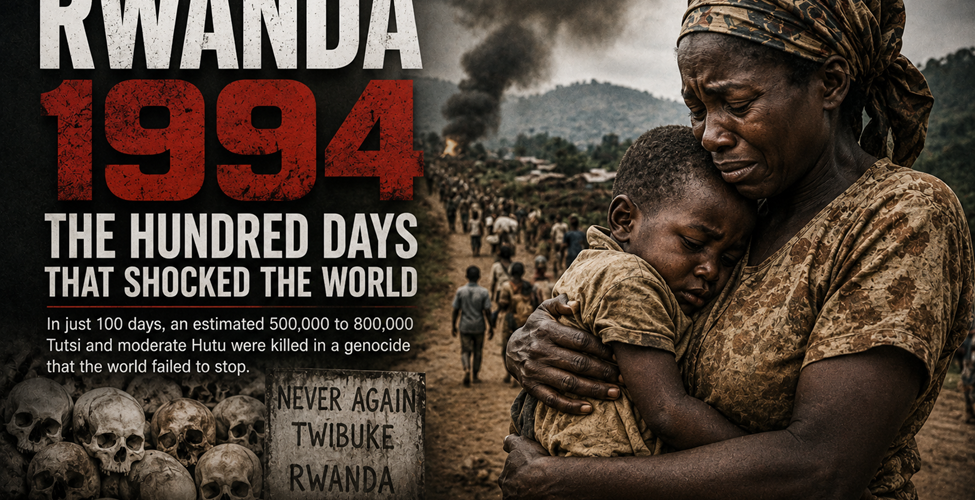
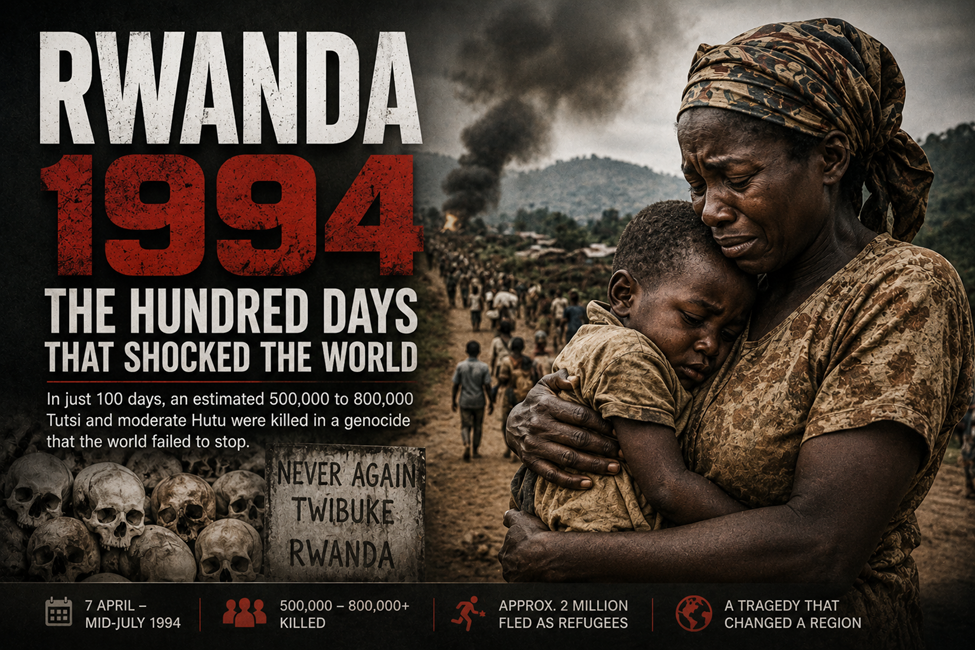
In just one hundred days, Rwanda experienced one of the fastest and most devastating episodes of mass killing in modern history.
Between April and July 1994, an estimated 500,000 to 800,000 people, most of them ethnic Tutsis, were killed as extremist Hutu leaders unleashed a campaign of violence that swept across the country. Some estimates place the death toll even higher, approaching one million.
The killings were carried out in towns, villages, churches, schools, and on roadsides. Neighbours turned against neighbours. Families were wiped out. Entire communities disappeared.
As the violence spread, the international community largely stood by, a failure that continues to be examined and debated decades later.
Today, the Rwandan Genocide is remembered not only for its scale and brutality, but also for the profound impact it had on Central Africa, triggering conflicts that would later engulf the Democratic Republic of Congo and claim millions more lives.
The Road to Catastrophe
The origins of the genocide stretch back to Rwanda’s colonial past.
During Belgian rule, ethnic distinctions between Hutu and Tutsi communities became deeply institutionalised through identity cards and administrative policies that reinforced divisions within society. Although Rwanda gained independence in 1962, those divisions remained a powerful force in national politics.
By the early 1990s, the country was already facing growing tensions.
In 1990, the Rwandan Patriotic Front, a rebel movement largely composed of Tutsi exiles based in Uganda, launched an armed campaign against the government. The conflict developed into a civil war that formally ended with the Arusha Peace Accords in 1993.
The agreement was intended to create a power sharing government, but hardline Hutu extremists opposed the deal. Over the following months, political leaders, state media outlets, and militia groups increasingly promoted anti Tutsi rhetoric and prepared for confrontation.
The country was moving steadily toward disaster.
The Spark That Ignited the Violence
On the evening of April 6, 1994, a plane carrying Rwandan President Juvénal Habyarimana was shot down as it approached Kigali.
The attack killed everyone on board and immediately plunged the country into crisis.
Within hours, roadblocks appeared across the capital. Lists of political opponents were distributed. Militias and security forces began targeting moderate Hutu politicians and Tutsi civilians.
Among the first victims was Prime Minister Agathe Uwilingiyimana, who was killed along with ten Belgian peacekeepers assigned to protect her.
The killings quickly spread across the country.
What followed was not spontaneous violence but a coordinated campaign that reached nearly every corner of Rwanda.
One Hundred Days of Terror
For the next three months, Rwanda descended into chaos.
Militia groups, including the Interahamwe and Impuzamugambi, worked alongside elements of the security forces to identify and kill Tutsi civilians. Local officials often participated in or organised attacks.
Many victims sought refuge in churches, schools, and government buildings, believing they would be protected. In numerous cases, those locations became sites of mass killings.
Unlike the industrial scale extermination seen during the Holocaust, much of the killing in Rwanda was carried out using machetes, clubs, and small arms.
The violence unfolded in full view of the world.
Despite warnings from diplomats, journalists, and United Nations officials on the ground, international intervention never materialised on a scale capable of stopping the massacre.
As the death toll mounted, United Nations peacekeeping forces were reduced rather than reinforced.
The Advance of the RPF
While the genocide was unfolding, the Rwandan Patriotic Front launched a military offensive from the north.
Led by Paul Kagame, the rebel movement steadily advanced toward Kigali and other major population centres.
By mid July 1994, the RPF had captured the capital and effectively ended the genocide.
The victory brought an end to the mass killings, but it also triggered a massive refugee crisis.
Approximately two million people fled Rwanda, many crossing into what was then Zaire, as well as Tanzania and Burundi. Among those refugees were thousands of individuals accused of participating in the genocide.
The movement of armed groups into eastern Zaire would have far reaching consequences for the entire region.
The Human Cost
The scale of human loss remains difficult to comprehend.
Most estimates place the death toll between 500,000 and 800,000 people, although some studies suggest the number may have been even higher.
Entire families were exterminated. Communities that had existed for generations were destroyed.
Beyond those who were killed, millions were displaced, creating one of the largest refugee crises in Africa’s modern history.
Survivors were left to rebuild their lives while coping with deep physical and psychological trauma.
The genocide also left behind thousands of orphaned children and countless victims of sexual violence.
Justice and Accountability
In the years that followed, Rwanda launched an extensive effort to hold those responsible accountable.
The United Nations established the International Criminal Tribunal for Rwanda, which prosecuted senior political and military figures accused of organising the genocide.
Inside Rwanda, traditional community based courts known as gacaca courts processed hundreds of thousands of cases involving lower level participants.
The judicial process became one of the largest accountability efforts ever undertaken after a mass atrocity.
While debates continue over aspects of justice and reconciliation, the trials established important legal precedents in international law concerning genocide and crimes against humanity.
A Legacy Beyond Rwanda
The consequences of the genocide extended far beyond Rwanda’s borders.
Armed groups that fled into eastern Zaire reorganised and continued operating near Rwanda’s frontier. Their presence became a major factor in Rwanda’s decision to intervene militarily across the border in 1996.
That intervention helped trigger the First Congo War.
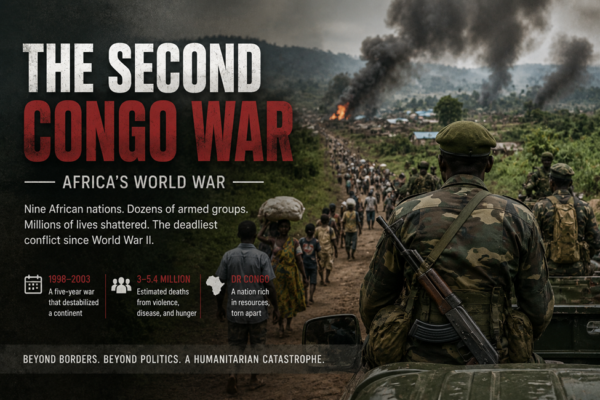
Two years later, a much larger regional conflict erupted, drawing in multiple African nations and becoming known as the Second Congo War.
Many of the tensions that emerged during the events of 1994 continue to influence relations between Rwanda and the Democratic Republic of Congo today.
For historians and conflict analysts, the Rwandan Genocide stands as both a warning and a lesson. It demonstrated how quickly political extremism, hate propaganda, and state backed violence can lead to catastrophe when institutions fail and the international community hesitates to act.

0 Comments
Leave a Comment