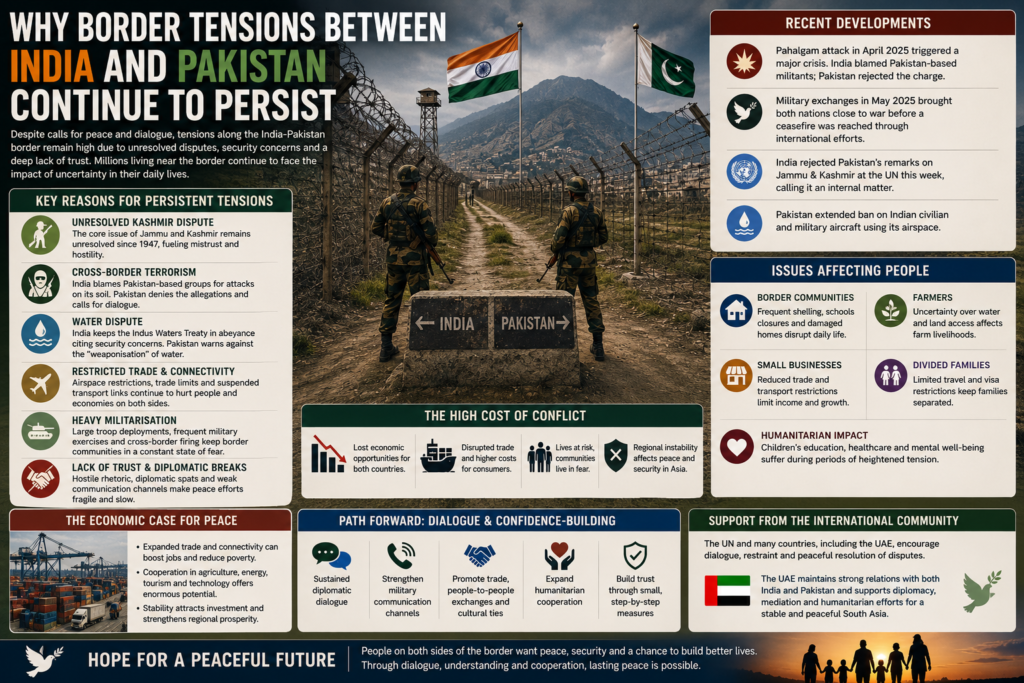
More than seven decades after their independence, India and Pakistan remain locked in one of the world’s most enduring and closely watched rivalries. Although both countries have avoided a full-scale war since their brief but intense military confrontation in May 2025, tensions along the border continue to persist, shaped by unresolved political disputes, security concerns, military deployments and a deep deficit of trust.
For the millions of people living near the Line of Control (LoC) in Jammu and Kashmir and the international border in Punjab and Rajasthan, the geopolitical rivalry is not an abstract strategic contest. It influences daily life, economic opportunities and the hope that future generations might grow up without the constant fear of renewed confrontation.
In villages close to the frontier, families continue to rebuild homes damaged during previous exchanges of fire, while farmers carefully monitor security advisories before tending fields that lie close to heavily militarised zones. Small traders who once relied on cross-border commerce describe a business environment shaped by uncertainty, while divided families remain separated by limited travel and suspended people-to-people exchanges.
“We simply want a normal life,” said a resident of a border village interviewed by local media. “When tensions rise, schools close, businesses suffer and everyone worries about what tomorrow will bring.”
The latest period of strain reflects several overlapping developments.
Relations deteriorated sharply following the deadly attack in Pahalgam in April 2025, which India blamed on Pakistan-based militants, an allegation Islamabad rejected while calling for an independent investigation. The crisis escalated into several days of military exchanges before international diplomatic efforts helped both sides reach a ceasefire that has largely held, despite occasional reports of localized incidents and continued political tensions.
While large-scale fighting has not resumed, the underlying issues that have historically strained bilateral relations remain unresolved.
India continues to emphasise that cross-border terrorism represents the principal obstacle to improved ties. Pakistan maintains that dialogue remains essential for addressing all outstanding issues, including Kashmir, while rejecting accusations of supporting militant violence. These fundamentally different narratives continue to shape official positions and complicate efforts to rebuild confidence.
Recent diplomatic exchanges illustrate how sensitive the relationship remains. This week, India strongly rejected Pakistan’s comments on Jammu and Kashmir during a United Nations forum, reiterating its longstanding position that the region is an internal matter.
Water security has also emerged as an increasingly significant point of contention.
India continues to maintain that the 1960 Indus Waters Treaty remains in abeyance following the 2025 crisis, linking any future restoration of the agreement to its security concerns. Pakistan has warned against what it describes as the “weaponisation” of water resources, arguing that uninterrupted river flows are critical for its agriculture, economy and food security.
The dispute has heightened anxieties among farming communities on both sides of the border, where rivers originating in the Himalayas support millions of livelihoods.
Meanwhile, practical measures introduced after last year’s crisis continue to affect ordinary citizens. Pakistan recently extended restrictions on Indian civilian and military aircraft using its airspace, while broader limitations on transport links and commercial exchanges remain in place. These measures have increased operating costs for airlines and further reduced already limited economic interaction between the neighbours.
Security infrastructure along the border has also expanded.
Indian authorities have intensified efforts to strengthen border management, including measures aimed at preventing infiltration, smuggling and other transnational crimes in frontier districts. Officials say these initiatives are intended to improve national security, while some local communities have raised concerns about their broader social and economic impact.
Despite persistent tensions, military analysts generally believe that both governments remain aware of the enormous risks associated with any major escalation between two nuclear-armed neighbours.
“The challenge is preventing isolated incidents from becoming strategic crises,” said a South Asia security analyst. “That requires reliable communication channels, political restraint and sustained diplomatic engagement, particularly during periods of heightened tension.”
The economic case for stability is equally compelling.
South Asia remains one of the world’s fastest-growing regions, yet economic cooperation between India and Pakistan remains far below its potential. Economists have long argued that expanded trade, improved transport connectivity and greater business engagement could generate employment, reduce costs for consumers and strengthen regional supply chains.
Communities on both sides of the border have repeatedly demonstrated an appetite for greater economic opportunity whenever political conditions permit. Business leaders have often noted that stable relations could benefit sectors ranging from agriculture and manufacturing to tourism and logistics.
Humanitarian considerations also remain central.
Although large-scale displacement associated with previous conflicts has eased, humanitarian organisations continue to emphasise the importance of protecting civilians living in border areas. Schools, healthcare facilities and essential infrastructure remain particularly vulnerable whenever tensions increase, reinforcing the need for confidence-building measures that minimise risks to local populations.
Regional and international partners continue to encourage dialogue.
The United Nations has consistently called for restraint and the peaceful resolution of disputes through diplomacy. Countries across the Gulf have likewise emphasised the importance of regional stability, recognising that peace in South Asia contributes to broader international economic security and supports global trade and investment.
The United Arab Emirates has maintained constructive relations with both India and Pakistan, reflecting its longstanding foreign policy centred on dialogue, mediation and practical cooperation. In recent years, the UAE has encouraged diplomatic engagement while supporting humanitarian initiatives and broader regional stability. Its balanced approach has positioned it as a trusted partner capable of maintaining communication with both sides during periods of heightened tension.
Analysts suggest that incremental confidence-building measures may offer the most realistic path forward. Expanding humanitarian cooperation, strengthening military communication mechanisms, facilitating limited commercial engagement and encouraging people-to-people exchanges could gradually help rebuild trust without requiring immediate agreement on more difficult political questions.
For families living near the border, such practical progress would have tangible benefits.
Children could attend school without frequent interruptions. Farmers could cultivate land with greater confidence. Traders could plan investments with less uncertainty. Divided families might once again hope for easier travel and more regular contact.
The persistence of India-Pakistan border tensions reflects a complex mix of history, security concerns and unresolved political disputes. Yet experience also shows that periods of dialogue have repeatedly reduced the risk of conflict and created opportunities for cooperation.
Lasting peace will not emerge from military deterrence alone. It will require sustained diplomacy, mutual confidence-building, humanitarian engagement and a shared recognition that regional stability ultimately serves the interests of both nations and the millions of people whose lives are shaped by the decisions made far from the border itself.


0 Comments
Leave a Comment